Let's get your family set up with Family AI

Submit
Thank you, we received your information. Look out for your Welcome Email with instructions on how to finish setting up your family profile. You might want to check your spam if you don't see your Welcome Email. To ensure you receive your risk alerts and weekly insights, please add hello@permission.ai to your contacts.
Oops! Something went wrong while submitting the form.
Back to Blog
May 14, 2025
|
Read time {time} min

Unlock the Power of ASK: How to Earn, Share, and Multiply Your Rewards

Written by
Permission
Stay in the loop

Get the latest insights, product updates, and news from Permission — shaping the future of user-owned data and AI innovation.

Subscribe

We are thrilled to announce Permission's new and generous referral program is now live, effective May 15, 2025.

At Permission, we believe your data is extremely valuable—and YOU should be rewarded when you share it. ASK is the fuel that powers your journey in the Permission ecosystem. As a Permission user, you’re not just taking back control of your data—you’re owning it and earning real rewards every step of the way.

Every time you show up, take action, or invite friends into Permission, you collect ASK tokens. These tokens track your contributions and grow your stake in a fair and transparent digital economy.

Think of ASK as your digital footprint. The more active you are—and the more friends you invite—the more you stack your ASK.

What Are ASK Tokens?

  • Sign Up and Verify: When you create and verify your Permission account, you earn ASK instantly.
  • Opt In to Share Your Data: Choose which data you share. Each time you participate in opt-in campaigns—whether completing a survey or engaging with a brand—you earn ASK based on the value of that data.
  • Refer Friends Who Sign Up and Verify: Share your unique referral link and earn ASK when your friends join Permission.
  • Earn on Your Referrals' Data Sharing Activities: When your direct referrals participate in data-sharing campaigns, you earn 10% of the ASK they earn—passive income generated simply by expanding your network.
  • Earn When Your Referrals Grow Their Network: When one of your direct referrals hits 10 successful referrals, you receive a one-time bonus of 10,000 ASK—and your referral earns 5,000 ASK for expanding the network.

The number of tokens you collect depends on how active you are and how big your referral network becomes. Every interaction adds to your ASK stack, growing your earnings with each new connection.

Invite and Earn More ASK

Inviting friends and family is where the exponential potential lies. Here is how our active Permission Referral Network works:

  1. Your invitee signs up and verifies their account.
  2. They receive their full signup reward immediately.
  3. You receive a signup bonus and 10 percent of any ASK they earn from data-sharing and campaigns.

There is no limit to the number of people you can invite. Each new verified user becomes a source of ongoing rewards.

Milestone Bonuses

We reward sustained growth. As your direct referrals accumulate, you unlock milestone bonuses:

  • 5 Referrals: Receive a one-time bonus of 5,000 ASK.
  • 10 Referrals: Receive a one-time bonus of 10,000 ASK.
  • Referral Milestones: When one of your direct referrals hits 10 successful referrals, you receive a one-time bonus of 10,000 ASK—and your referral earns 5,000 ASK for expanding the network.

Top referrers gain early access to special earning opportunities and beta features.

How It Works in Practice

Your referral earnings are calculated and disbursed once a month to keep things predictable. Here is the timeline:

  1. By the end of each month: We tally all new direct referrals who have signed up, verified, and engaged.
  2. On the 15th of the next month: We deposit your 10 percent of their earned ASK and any milestone rewards directly into your Permission wallet.
  3. Dashboard Access: You can view detailed referral and bonus history on your dashboard at any time.

Real-World Examples

Example 1: Alex's Growth Story

Alex invites Jamie to Permission. Jamie signs up and verifies her account, earning 1,000 ASK. Alex also receives 1,000 ASK as a signup bonus. Over the next month, Jamie shares her data and completes campaigns, earning 5,000 ASK. Alex gets 10%, receiving 500 ASK automatically.

The next month, Jamie refers her friend Morgan, who signs up, verifies, and starts earning ASK. Because Morgan is part of Jamie’s network, Alex earns another 10% of Morgan’s ASK activity, all without lifting a finger.

By the end of three months, Alex has earned 1,000 ASK (signup), 500 ASK (Jamie's activity), and 200 ASK (Morgan's activity) — 1,700 ASK in total from just one initial referral.

Bonus Time: In Month 4, Jamie reaches 10 successful referrals. Alex receives a 10,000 ASK bonus, and Jamie earns 5,000 ASK as a reward for building her network.

Example 2: Building a Passive ASK Tree

Imagine Sarah refers five friends, each of whom verifies and starts earning ASK. Sarah receives 1,000 ASK per friend, totaling 5,000 ASK. Now, those friends begin referring others. Sarah not only receives 10% of her direct referrals' earnings but also hits the Milestone Bonus for 5 referrals, unlocking an additional 5,000 ASK.

Sarah’s network continues to grow, each branch feeding back into her ASK balance. This is the true power of exponential growth—small actions that multiply into real, ongoing rewards.

The Power of Quality Over Quantity

The real secret to maximizing your ASK earnings isn’t just about bringing in tons of people—it’s about bringing in the right people. High-quality, engaged users mean more data sharing, more opt-ins, and more ASK flowing back to you.

Invite friends, colleagues, family—anyone who wants to take control of their data and earn along the way. One good referral can spark a whole network of growth.

Why This Matters: Passive Earnings and Data Monetization

When brands use that zero-party data for targeted marketing, or when it’s fed into AI models to power smarter campaigns, you earn even more ASK.

Every time your data is used in an AI marketing campaign, you get paid. And when your referrals permission their data and it’s leveraged in targeted advertising, YOU EARN TOO.

Stack Your ASK: More Data, More Earnings

One of the biggest opportunities within the Permission ecosystem is the ability to stack your ASK. The more data you share—on your terms—the more you earn.

  • Wallet connections: Share on-chain data for deeper insights and earn more.
  • Survey participation: Answer questions about your preferences and earn additional ASK.
  • Permission Connect: Opt into branded offers and get rewarded instantly.
  • AI-Powered Campaigns: When your data is fed into AI models for targeted marketing, you continue to earn ASK.

Every click, every share, and every opt-in that happens in your network stacks your ASK. And when you invite others, that stack only grows. It’s not just about earning—it’s about building a foundation for passive income that lasts.

Get Ready. Start Earning. Own Your Data.

This is just the beginning. The Permission Referral Network will change how you think about earning online. Don’t just watch it happen—be a part of it.

Getting Started Is Simple

  1. Verify your account today to claim your first ASK.
  2. Copy your referral link from the dashboard.
  3. Share it with friends, family, and colleagues.
  4. Watch your network grow and check your wallet on the 15th of each month for bonus deposits.

There’s no ceiling on what you can earn. Build your referral tree, engage with offers, and let ASK work for you—month after month.

Join the Permission Referral Network today. Share your link, build your network, and multiply your rewards.

For more information about eligibility and other Referral Program details, please refer to our Terms of Use.

Recent articles

What Every Parent Needs to Know Before Handing Over the iPad

Apr 7th, 2026
|
{time} read time

Spring Break used to mean board games and bike rides.

Now it means 8+ hours a day on TikTok, Roblox, Snapchat.

Most kids are back in school now. But if you noticed something a little off this past week, you're not imagining it. If you're still bracing for the screentime fights, the "just five more minutes" negotiations, the device-at-dinner standoffs, you're not alone. But there's a better way to handle this than becoming the screentime police.

Here's what's actually happening on your kids' devices, and what you can do about it:

The honest truth: more free time = higher risk of social media addiction

During school breaks, kids average 3.5-4 extra hours of screen time per day.

That's not just YouTube and Minecraft. That's unstructured time on platforms that are designed by teams of engineers and behavioral psychologists to keep your child scrolling, clicking, and coming back.

In 2026, it's not just the amount that's shifted — since 2020, daily time on short-form video like TikTok and Reels has increased 14x for younger children.

This isn't an accident. A former Meta researcher described Instagram internally as "a drug." A YouTube internal document listed "viewer addiction" as a goal. A Meta employee even told colleagues: “We're basically pushers.”

Spring Break is one of the highest-risk weeks of the year for unsupervised screen use. More free time, less structure, and the same algorithms running 24 hours a day, messing with your children's attention around the clock.

What's actually happening on the platforms your kids use most

TikTok and Instagram use dopamine loops, short bursts of reward, to make scrolling feel impossible to stop. There is no natural endpoint. The algorithm learns what keeps your child watching and serves more of it, regardless of whether it's healthy. Landmark 2026 jury verdicts have recently found these platforms liable for intentionally designing addictive features that contribute to depression and anxiety in minors.

Roblox and Discord are where a lot of the real danger hides. Unmoderated voice chat, private group invitations, and off-platform contact attempts are common. Predators use these platforms specifically because parents underestimate them. Current multidistrict litigation (MDL 3166) alleges that these companies have failed to implement basic safeguards to prevent the grooming and exploitation of children.

Character.ai and ChatGPT don't verify ages. Kids as young as 8 are forming emotional attachments to AI companions, sharing things they'd never tell a parent or friend. There is no guardrail on what those conversations become. Recent wrongful death lawsuits highlight cases where minors engaged in harmful, obsessive relationships with AI, leading to tragic outcomes.

Snapchat was built around disappearing content, which means disappearing evidence. AI nudification tools are now accessible to teenagers directly through third-party apps that connect to Snapchat. State Attorneys General in Texas and New Mexico have filed suits alleging the platform is a "marketplace for predators" and facilitates the spread of non-consensual deepfake material.

This isn't about scaring you. It's about making sure you're not the last to know.

Stop being the screentime police. Become their coach instead.

Here's the shift that actually works.

The screentime police approach, counting minutes, setting timers, fighting nightly, doesn't build safe habits. It builds resentment. And the moment your kid is out from under your roof, those habits disappear entirely.

The better approach is mentorship. Think about how a great coach works. They don't bench their best player for making a mistake. They show them what went wrong, explain why it matters, and help them do better next time. That's what your kid needs from you on digital safety.

That means shifting from how long they're on a device to what they're seeing and whether they know how to handle it. A 15-minute conversation about what to do when a stranger DMs them on Discord is worth more than a screentime timer.

You don't need to be a tech expert to have that conversation. You just need the right information and the right words.

Three things to do this week (that aren't "take the phone away")

  1. Know which platforms they're actually using. Ask your kid to show you their five most-used apps. Don't make it an interrogation, make it curious. "What's this one? What do you do on it?" You'll learn more in five minutes than any parental control software will tell you.
  2. Have one real conversation, not ten small arguments. Pick a moment when you're both relaxed, not when you're already frustrated about screen time. Tell them what you know about how these platforms work. Not to lecture, to inform. Kids respond much better to "here's how TikTok is designed to keep you scrolling" than "put the phone down."
  3. Set expectations together, not rules from above. Ask your kid what they think fair looks like. You'll be surprised. Most kids actually have a sense of what's healthy, they just need permission to use it. Building the agreement together means they're far more likely to stick to it.

What your family values have to do with it

Every family is different. What's acceptable in one household isn't in another, and that's exactly how it should be.

The problem with most parental control tools is that they're built around a one-size-fits-all set of restrictions. Block this app. Limit that one. It creates friction, not understanding.

The better approach starts with your values. What do you actually care about for your kids? Safety, yes, but also independence, trust, and the skills they'll need when you're not there. The goal isn't to block everything. It's to raise a kid who makes good choices when you're not in the room.

Trusted AI for the Family. Built for Spring Break and beyond.

This is exactly why we built Permission AI for the Family.

It's not a parental control app. It's an AI that works with your family, surfacing what's actually happening on the platforms your kids use, giving you the scripts to have real conversations, and helping your kids build safe habits that last beyond Spring Break.

It's built around your values and your boundaries, not ours.

And right now, it's 100% free. That's a $240 annual value, at no cost.

If you've been meaning to get a better handle on your family's digital life, this is the week to do it.

Get Trusted AI for the Family — free at permission.ai/for-parents

Insights

Parenting In the Age of AI: Why Tech Is Making Parenting Harder – and What Parents Can Do

Jan 29th, 2026
|
{time} read time

Many parents sense a shift in their children’s environment but can’t quite put their finger on it.

Children aren't just using technology. Conversations, friendships, and identity formation are increasingly taking place online - across platforms that most parents neither grew up with nor fully understand. 

Many parents feel one step behind and question: How do I raise my child in a tech world that evolves faster than I can keep up with?

Why Parenting Feels Harder in the Digital Age

Technology today is not static. AI-driven and personalized platforms adapt faster than families can.

Parents want to raise their children to live healthy, grounded lives without becoming controlling or disconnected. Yet, many parents describe feeling:

  • “Outpaced by the evolution of AI and Algorithms”
  • “Disconnected from their children's digital lives”
  • “Concerned about safety when AI becomes a companion”
  • “Frustrated with insufficient traditional parental controls”

Research shows this shift clearly:

  • 66% of parents say parenting is harder today than 20 years ago, citing technology as a key factor. 
  • Reddit discussions reveal how parents experience a “nostalgia gap,”  in which their own childhoods do not resemble the digital worlds their children inhabit.
  • 86% of parents set rules around screen use, yet only about 20% follow these rules consistently, highlighting ongoing tension in managing children’s device use.

Together, these findings suggest that while parents are trying to manage technology, the tools and strategies available to them haven’t kept pace with how fast digital environments evolve.

Technology has made parenting harder.

The Pressure Parents Face Managing Technology

Parents are repeatedly being told that managing their children's digital exposure is their responsibility.

The message is subtle but persistent: if something goes wrong, it’s because “you didn’t do enough.”

This gatekeeper role is an unreasonable expectation. Children’s online lives are always within reach, embedded in education, friendships, entertainment, and creativity. Expecting parents to take full control overlooks the reality of modern childhood, where digital life is constant and unavoidable.

This expectation often creates chronic emotional and somatic guilt for parents. At the same time, AI-driven platforms are continuously optimized to increase engagement in ways parents simply cannot realistically counter.

As licensed clinical social worker Stephen Hanmer D'Eliía explains in The Attention Wound: What the attention economy extracts and what the body cannot surrender, "the guilt is by design." Attention-driven systems are engineered to overstimulate users and erode self-regulation (for children and adults alike). Parents experience the same nervous-system overload as their kids, while lacking the benefit of growing up with these systems. These outcomes reflect system design, not parental neglect.

Ongoing Reddit threads confirm this reality. Parents describe feeling behind and uncertain about how to guide their children through digital environments they are still learning to understand themselves. These discussions highlight the emotional and cognitive toll that rapidly evolving technology places on families.

Parenting In A Digital World That Looks Nothing Like The One We Grew Up In

Many parents instinctively reach for their own childhoods as a reference point but quickly realize that comparison no longer works in today’s world.  Adults remember life before smartphones; children born into constant digital stimulation have no such baseline.

Indeed, “we played outside all day” no longer reflects the reality of the world children are growing up in today. Playgrounds are now digital. Friendships, humor, and creativity increasingly unfold online.

This gap leaves parents feeling unqualified. Guidance feels harder when the environment is foreign, especially when society expects and insists you know how.

Children Are Relying on Chatbots for Emotional Support Over Parents

AI has crossed a threshold: from tool to companion.

Children are increasingly turning to chatbots for conversation and emotional support, often in private.

About one-in-ten parents with children ages 5-12 report that their children use AI chatbots like ChatGPT or Gemini. They ask personal questions, share worries, and seek guidance on topics they feel hesitant to discuss with adults.

Many parents fear that their child may rely on AI first instead of coming to them. Psychologists warn that this shift is significant because AI is designed to be endlessly available and instantly responsive (ParentMap, 2025).

Risks include:

  • Exposure to misinformation.
  • Emotional dependency on systems that can simulate care but cannot truly understand or respond responsibly.
  • Blurred boundaries between human relationships and machine interaction.

Reporting suggests children are forming emotionally meaningful relationships with AI systems faster than families, schools, and safeguards can adapt (Guardian, 2025; After Babel, 2025b)

Unlike traditional tools, AI chatbots are built for constant availability and emotional responsiveness, which can blur boundaries for children still developing judgment and self-regulation — and may unintentionally mirror, amplify, or reinforce negative emotions instead of providing the perspective and limits that human relationships offer.

Why Traditional Parental Controls are Failing

Traditional parental controls were built for an “earlier internet,” one where parents could see and manage their children online. Today’s internet is algorithmic.

Algorithmic platforms bypass parental oversight by design. Interventions like removing screens or setting limits often increase conflict, secrecy, and addictive behaviors rather than teaching self-regulation or guiding children on how to navigate digital spaces safely (Pew Research, 2025; r/Parenting, 2025).

A 2021 JAMA Network study found video platforms popular with kids use algorithms to recommend content based on what keeps children engaged, rather than parental approval. Even when children start with neutral searches, the system can quickly surface videos or posts that are more exciting. These algorithms continuously adapt to a child’s behavior, creating personalized “rabbit holes” of content that change faster than any screen-time limit or parental control can manage.

Even the most widely used parental control tools illustrate this limitation in practice, focusing on: 

  • reacting after exposure (Bark)
  • protecting against external risks (Aura)
  • limiting access (Qustodio)
  • tracking physical location (Life360)

What they largely miss is visibility into the algorithmic systems and personalized feeds that actively shape children’s digital experiences in real time.

A Better Approach to Parenting in the Digital Age

In a world where AI evolves faster than families can keep up, more restrictions won’t solve the disconnection between parents and children. Parents need tools and strategies that help them stay informed and engaged in environments they cannot fully see or control.

Some companies, like Permission, focus on translating digital activity into clear insights, helping parents notice patterns, understand context, and respond thoughtfully without prying.

Raising children in a world where AI moves faster than we can keep up is about staying present, understanding the systems shaping children’s digital lives, and strengthening the human connection that no algorithm can replicate.

What Parents Can Do in a Rapidly Changing Digital World

While no single tool or rule can solve these challenges, many parents ask what actually helps in practice.

Below are some of the most common questions parents raise — and approaches that research and lived experience suggest can make a difference.

Do parents need to fully understand every app, platform, or AI tool their child uses?

No. Trying to keep up with every platform or feature often increases stress without improving outcomes.

What matters more is understanding patterns: how digital use fits into a child’s routines, moods, sleep, and social life over time. Parents don’t need perfect visibility into everything their child does online; they need enough context to notice meaningful changes and respond thoughtfully.

What should parents think about AI tools and chatbots used by kids?

AI tools introduce a new dynamic because they are:

  • always available
  • highly responsive
  • designed to simulate conversation and support

This matters because children may turn to these tools privately, for curiosity, comfort, or companionship. Rather than reacting only to the technology itself, parents benefit from understanding how and why their child is using AI, and having age-appropriate conversations about boundaries, trust, and reliance.

How can parents stay involved without constant monitoring or conflict?

Parents are most effective when they can:

  • notice meaningful shifts early
  • understand context before reacting
  • talk through digital choices rather than enforce rules after the fact

This shifts digital parenting from surveillance to guidance. When children feel supported rather than watched, conversations tend to be more open, and conflict is reduced.

What kinds of tools actually support parents in this environment?

Tools that focus on insight rather than alerts, and patterns rather than isolated moments, are often more helpful than tools that simply report activity after something goes wrong.

Some approaches — including platforms like Permission — are designed to translate digital activity into understandable context, helping parents notice trends, ask better questions, and stay connected without hovering. The goal is to support parenting decisions, not replace them.

The Bigger Picture

Parenting in the age of AI isn’t about total control, and it isn’t about stepping back entirely.

It’s about helping kids:

  • develop judgment
  • understand digital influence
  • build healthy habits
  • stay grounded in human relationships

As technology continues to evolve, the most durable form of online safety comes from understanding, trust, and connection — not from trying to surveil or outpace every new system.

Project Updates

How You Earn with the Permission Agent

Jan 28th, 2026
|
{time} read time

The Permission Agent was built to do more than sit in your browser.

It was designed to work for you: spotting opportunities, handling actions on your behalf, and making it super easy to earn rewards as part of your everyday internet use. 

Here’s how earning works with the Permission Agent.

Earning Happens Through the Agent

Earning with Permission is powered by Agent-delivered actions designed to support the growth of the Permission ecosystem.

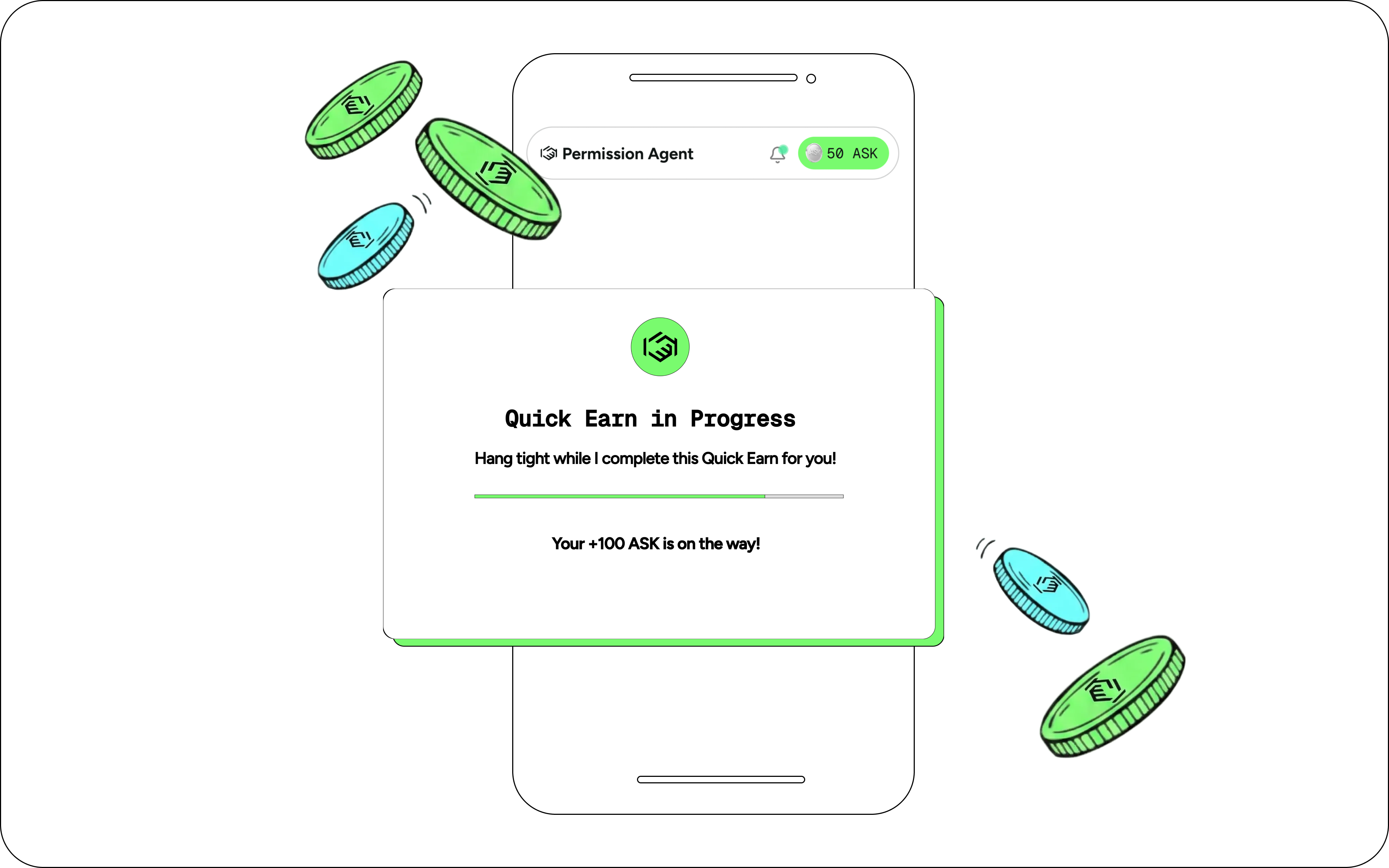
Rewards come through Rewarded Actions and Quick Earns, surfaced directly inside the Agent. When you use the Agent regularly, you’ll see clear, opt-in earning opportunities presented to you.

Importantly, earning is no longer based on passive browsing. Instead, opportunities are delivered intentionally through actions you choose to participate in, with rewards disclosed upfront.

You don’t need to search for offers or manage complex workflows. The Agent organizes opportunities and helps carry out the work for you.

Daily use is how you discover what’s available.

Rewarded Actions and Quick Earns

Rewarded Actions and Quick Earns are the primary ways users earn ASK through the Agent.

These opportunities may include:

  • Supporting Permission launches and initiatives
  • Participating in community programs or campaigns
  • Sharing Permission through guided promotional actions
  • Taking part in contests or time-bound promotions

All opportunities are presented clearly through the Agent, participation is always optional, and rewards are transparent.

The Agent Does the Work

What makes earning different with Permission is the Agent itself.

You choose which actions to participate in, and the Agent handles execution - reducing friction while keeping you in control. Instead of completing repetitive steps manually, the Agent performs guided tasks on your behalf, including mechanics behind promotions and referrals.

The result: earning ASK feels lightweight and natural because the Agent handles the busywork.

The more consistently you use the Agent, the more opportunities you’ll see.

Referrals and Lifetime Rewards

Referrals remain one of the most powerful ways to earn with Permission.

When you refer someone to Permission:

  • You earn when they become active
  • You continue earning as their activity grows
  • You receive ongoing rewards tied to the value created by your referral network

As your referrals use the Permission Agent, it becomes easier for them to discover earning opportunities - and as they earn more, so do you.

Referral rewards operate independently of daily Agent actions, allowing you to build long-term, compounding value.

Learn more here:
👉 Unlock Rewards with the Permission Referral Program

What to Expect Over Time

As the Permission ecosystem grows, earning opportunities will expand.

You can expect:

  • New Rewarded Actions and Quick Earns delivered through the Agent
  • Campaigns tied to community growth and product launches
  • Opportunities ranging from quick wins to more meaningful rewards

Checking in with your Agent regularly is the best way to stay up to date.

Getting Started

Getting started takes just a few minutes:

  1. Install the Permission Agent
  2. Sign in and activate it
  3. Use the Agent daily to see available Rewarded Actions and Quick Earns

From there, the Agent takes care of the rest - helping you participate, complete actions, and earn ASK over time.

Built for Intentional Participation

Earning with the Permission Agent is designed to be clear, intentional, and sustainable.

Rewards come from choosing to participate, using the Agent regularly, and contributing to the growth of the Permission ecosystem. The Agent makes that participation easy by handling the work - so value flows back to you without unnecessary effort.

Insights

2026: The Year of Disruption – Trust Becomes the Most Valuable Commodity

Jan 23rd, 2026
|
{time} read time

Moore’s Law is still at work, and in many ways it is accelerating.

AI capabilities, autonomous systems, and financial infrastructure are advancing faster than our institutions, norms, and governance frameworks can absorb. For that acceleration to benefit society at a corresponding rate, one thing must develop just as quickly: trust.

2026 will be the year of disruption across markets, government, higher education, and digital life itself. In every one of those domains, trust becomes the premium asset. Not brand trust. Not reputation alone. But verifiable, enforceable, system-level trust.

Here’s what that means in practice.

1. Trust Becomes Transactional, not Symbolic

Trust between agents won’t rely on branding or reputation alone. It will be built on verifiable exchange: who benefits, how value is measured, and whether compensation is enforceable. Trust becomes transparent, auditable, and machine-readable.

2. Agentic Agents Move from Novelty to Infrastructure

Autonomous, goal-driven AI agents will quietly become foundational internet infrastructure. They won’t look like apps or assistants. They will operate continuously, negotiating, executing, and learning across systems on behalf of humans and institutions.

The central challenge will be trust: whether these agents are acting in the interests of the humans, organizations, and societies they represent, and whether that behavior can be verified.

3. Agent-to-Agent Interactions Overtake Human-Initiated Ones

Most digital interactions in 2026 won’t start with a human click. They will start with one agent negotiating with another. Humans move upstream, setting intent and constraints, while agents handle execution. The internet becomes less conversational and more transactional by design.

4. Agent Economies Force Value Exchange to Build Trust

An economy of autonomous agents cannot run on extraction if trust is to exist.

In 2026, value exchange becomes mandatory, not as a monetization tactic, but as a trust-building mechanism. Agents that cannot compensate with money, tokens, or provable reciprocity will be rate-limited, distrusted, or blocked entirely.

“Free” access doesn’t scale in a defended, agent-native internet where trust must be earned, not assumed.

5. AI and Crypto Converge, with Ethereum as the Coordination Layer

AI needs identity, ownership, auditability, and value rails. Crypto provides all four. In 2026, the Ethereum ecosystem emerges as the coordination layer for intelligent systems exchanging value, not because of speculation, but because it solves real structural problems AI cannot solve alone.

6. Smart Contracts Evolve into Living Agreements

Static smart contracts won’t survive an agent-driven economy. In 2026, contracts become adaptive systems, renegotiated in real time as agents perform work, exchange data, and adjust outcomes. Law doesn’t disappear. It becomes dynamic, executable, and continuously enforced.

7. Wall Street Embraces Tokenization

By 2026, Wall Street fully embraces tokenization. Stocks, bonds, options, real estate interests, and other financial instruments move onto programmable rails.

This shift isn’t about ideology. It’s about efficiency, liquidity, and trust through transparency. Tokenization allows ownership, settlement, and compliance to be enforced at the system level rather than through layers of intermediaries.

8. AI-Driven Creative Destruction Accelerates

AI-driven disruption accelerates faster than institutions can adapt. Entire job categories vanish while new ones appear just as quickly.

The defining risk isn’t displacement. It’s erosion of trust in companies, labor markets, and social contracts that fail to keep pace with technological reality. Organizations that acknowledge disruption early retain trust. Those that deny it lose legitimacy.

9. Higher Education Restructures

Higher education undergoes structural change. A $250,000 investment in a four-year degree increasingly looks misaligned with economic reality. Companies begin to abandon degrees as a default requirement.

In their place, trust shifts toward social intelligence, ethics, adaptability, and demonstrated achievement. Proof of capability matters more than pedigree. Continuous learning matters more than static credentials.

Institutions that understand this transition retain relevance. Those that don’t lose trust, and students.

10. Governments Face Disruption From Systems They Don’t Control

AI doesn’t just disrupt industries. It disrupts governance itself. Agent networks ignore borders. AI evolves faster than regulation. Value flows escape traditional jurisdictional controls.

Governments face a fundamental choice: attempt to reassert control, or redesign systems around participation, verification, and trust. In 2026, adaptability becomes a governing advantage.

Conclusion

Moore’s Law hasn’t slowed. It has intensified. But technological acceleration without trust leads to instability, not progress.

2026 will be remembered as the year trust became the scarce asset across markets, government, education, and digital life.

The future isn’t human versus AI.

It’s trust-based systems versus everything else.