

Submit
Thank you! Your submission has been received!
Oops! Something went wrong while submitting the form.
Back to Blog

The Ultimate Guide to Maximizing Cash Back Credit Card Rewards

February 4, 2023
|
Read time {time} min
Written by
Permission
Stay in the loop

Get the latest insights, product updates, and news from Permission — shaping the future of user-owned data and AI innovation.

Subscribe

Cash back credit cards offer a fantastic opportunity to earn rewards simply by using your card for everyday purchases. With numerous options available, it’s crucial to know how to maximize these rewards and make the most of your spending. In this ultimate guide, we’ll provide detailed information and expert tips to help you make the most of your cash back credit card rewards.

Choosing the Right Cash Back Credit Card

Which credit reward card should you use?

Selecting the right credit card for your needs is vital for maximizing cash back rewards. Start by comparing reward rates and looking for a card that offers a competitive cash back rate, such as 1.5% or higher on all purchases. Consider bonus categories that align with your spending habits, as some cards offer higher cash back rates on specific categories like groceries, gas, or dining. Factor in any annual fees and ensure the rewards you’ll earn justify the cost. Lastly, explore redemption options, as some cards offer statement credits, while others let you redeem for gift cards, travel, or merchandise.

Understanding Reward Categories

Different cash back cards offer varying rewards based on specific spending categories. Flat-rate cash back cards provide a fixed percentage of cash back on all purchases, making them straightforward and easy to use. An example of a flat-rate cash back card is the Citi Double Cash Card, which offers 1% cash back on all purchases when you make them and an additional 1% when you pay off your balance, effectively providing a 2% cash back rate on all spending.

3 main credit card types

Cash back, Points, Miles

On the other hand, tiered cash back cards offer higher cash back rates on specific categories and a lower rate on all other purchases. These cards reward you more for spending in certain areas, such as groceries or dining. For example, the Blue Cash Preferred Card from American Express offers 6% cash back on U.S. supermarket purchases (on up to $6,000 per year, then 1%), 6% cash back on select U.S. streaming subscriptions, 3% cash back on U.S. gas station and transit purchases, and 1% cash back on all other purchases.

In contrast, rotating category cards provide elevated cash back rates on certain categories that change every quarter, requiring activation each time to earn the higher rate. By understanding the differences between flat-rate, tiered, and rotating category cards, you can choose the card that best aligns with your spending habits and maximize your cash back rewards.

Maximizing Rewards with Strategic Spending

Strategically using your card can help make the most of your cash back rewards. Focus your spending on the categories that earn higher cash back rates, such as using your card for grocery purchases if it offers bonus rewards in that category. Plan your spending around the rotating categories to maximize rewards, and take advantage of shopping portals and apps provided by your credit card issuer to earn additional rewards.

Utilizing Signup Bonuses

Many cash back cards offer signup bonuses for new cardholders who meet specific spending thresholds within a certain time frame. Taking advantage of these bonuses can significantly boost your rewards. For example, the Chase Freedom Unlimited Card is offering a signup bonus of $200 after new cardholders spend $800 on purchases within the first three months of account opening. This bonus provides a substantial boost to the rewards earned through the card’s regular cash back program.

To find the most current high promotional credit card signup bonuses, it’s essential to check the websites of major credit card issuers, as well as reliable sources like financial news websites, credit card comparison platforms, and popular forums. Websites such as Reddit and community-driven platforms like MyFICO Forums, FlyerTalk, and BoardingArea often feature dedicated sections or threads where users share the latest news and deals on credit card offers, including signup bonuses. Utilizing these resources will help you stay informed about the best cash back credit card offers available, enabling you to make informed decisions and maximize your rewards.

Combining Multiple Cash Back Cards

Using multiple cash back cards, each with different reward categories, can maximize your rewards on various purchases. Be strategic in using the right card for each purchase to ensure you’re earning the highest cash back rate possible.

Staying Organized with Tracking and Redemption

Stay organized and track your rewards by monitoring your spending, setting up alerts from your credit card issuer, and being proactive in redeeming your rewards for statement credits, gift cards, or other options.

Taking Advantage of Additional Perks and Benefits

Cash back credit cards often come with additional perks and benefits that can enhance your overall credit card experience and help you save even more. For example, the Citi Double Cash Card offers a price protection feature, allowing you to receive a refund if the price of a purchased item drops within a specified time frame. The American Express Blue Cash Preferred Card provides purchase protection, which covers eligible items against theft or damage for a certain period after purchase. The Chase Freedom Unlimited Card extends warranties on eligible items, offering extra peace of mind.

Additionally, some cash back credit cards provide exclusive discounts and offers with partner merchants. For instance, the Bank of America Cash Rewards Credit Card includes the BankAmeriDeals program, which allows cardholders to earn extra cash back at select merchants.

By following the steps outlined in this guide, you can maximize your cash back credit card rewards and turn your everyday spending into valuable savings. Stay organized, monitor your spending, and regularly redeem your rewards to get the most out of your cash back credit cards.

Be Mindful of Credit Utilization and Timely Payments

Another important aspect of maximizing cash back credit card rewards is being mindful of your credit utilization ratio and making timely payments. Your credit utilization ratio is the percentage of your available credit that you’re using, and it plays a significant role in determining your credit score. Aim to keep your credit utilization below 30% to maintain a healthy credit score, which can help you qualify for better credit card offers with higher rewards in the future.
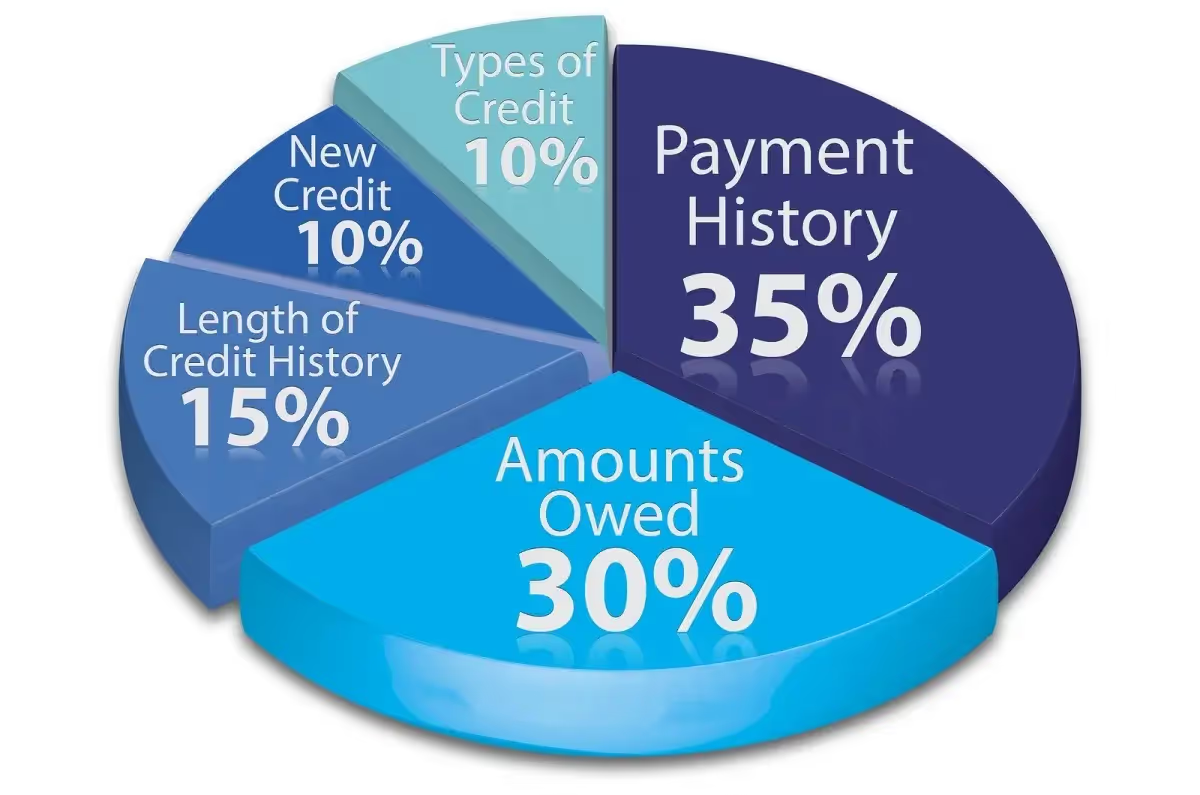
Making timely payments on your cash back credit card is also crucial. Missing payments can lead to late fees, penalty interest rates, and a negative impact on your credit score. Set up payment reminders or automatic payments to ensure you never miss a due date. By consistently making on-time payments, you’ll not only maintain a good credit score but also avoid any negative consequences that could hinder your ability to maximize cash back rewards.

Regularly Review and Optimize Your Credit Card Portfolio

To ensure you’re continually getting the most out of your cash back credit cards, it’s essential to regularly review and optimize your credit card portfolio. The credit card market is constantly evolving, with new offers and reward structures being introduced frequently. Keep an eye on new cash back credit card offers and compare them to your existing cards to determine if there’s an opportunity to upgrade or switch to a card with better rewards or perks.

Additionally, as your spending habits change over time, it’s essential to reevaluate your credit card portfolio to ensure it still aligns with your needs. For example, if you find yourself traveling more frequently, you might consider adding a travel rewards credit card to your portfolio to maximize rewards on travel-related expenses.

The Bottom Line

By following the steps and strategies outlined in this guide, you’ll be well on your way to maximizing your cash back credit card rewards and enjoying the numerous benefits that come with savvy credit card usage. Remember to choose the right card, stay organized, and regularly review your credit card portfolio to ensure you’re always getting the most value from your cash back credit cards.

As you explore the world of rewards and loyalty programs, it’s also worth considering the potential advantages of Web3-based rewards systems. Our company, Permission.io, is revolutionizing rewards by offering our unique $ASK points* in exchange for users’ data. This innovative approach not only empowers users by compensating them for their valuable information but also introduces them to the dynamic world of Web3.

Keep an eye out for future articles that dive deeper into the benefits of Web3 rewards systems like our $ASK token, and learn how they can complement and enhance your rewards-earning strategies. Happy earning!

*Please note that $ASK points are virtual tokens that can be redeemed for various crypto rewards.

Explore the Permission Platform

Unlock the value of your online experience.

Light gradient background transitioning from white to pale green with a subtle grainy texture.

Recent articles

Insights

Parenting In the Age of AI: Why Tech Is Making Parenting Harder – and What Parents Can Do

Jan 29th, 2026
|
{time} read time

Many parents sense a shift in their children’s environment but can’t quite put their finger on it.

Children aren't just using technology. Conversations, friendships, and identity formation are increasingly taking place online - across platforms that most parents neither grew up with nor fully understand. 

Many parents feel one step behind and question: How do I raise my child in a tech world that evolves faster than I can keep up with?

Why Parenting Feels Harder in the Digital Age

Technology today is not static. AI-driven and personalized platforms adapt faster than families can.

Parents want to raise their children to live healthy, grounded lives without becoming controlling or disconnected. Yet, many parents describe feeling:

  • “Outpaced by the evolution of AI and Algorithms”
  • “Disconnected from their children's digital lives”
  • “Concerned about safety when AI becomes a companion”
  • “Frustrated with insufficient traditional parental controls”

Research shows this shift clearly:

  • 66% of parents say parenting is harder today than 20 years ago, citing technology as a key factor. 
  • Reddit discussions reveal how parents experience a “nostalgia gap,”  in which their own childhoods do not resemble the digital worlds their children inhabit.
  • 86% of parents set rules around screen use, yet only about 20% follow these rules consistently, highlighting ongoing tension in managing children’s device use.

Together, these findings suggest that while parents are trying to manage technology, the tools and strategies available to them haven’t kept pace with how fast digital environments evolve.

Technology has made parenting harder.

The Pressure Parents Face Managing Technology

Parents are repeatedly being told that managing their children's digital exposure is their responsibility.

The message is subtle but persistent: if something goes wrong, it’s because “you didn’t do enough.”

This gatekeeper role is an unreasonable expectation. Children’s online lives are always within reach, embedded in education, friendships, entertainment, and creativity. Expecting parents to take full control overlooks the reality of modern childhood, where digital life is constant and unavoidable.

This expectation often creates chronic emotional and somatic guilt for parents. At the same time, AI-driven platforms are continuously optimized to increase engagement in ways parents simply cannot realistically counter.

As licensed clinical social worker Stephen Hanmer D'Eliía explains in The Attention Wound: What the attention economy extracts and what the body cannot surrender, "the guilt is by design." Attention-driven systems are engineered to overstimulate users and erode self-regulation (for children and adults alike). Parents experience the same nervous-system overload as their kids, while lacking the benefit of growing up with these systems. These outcomes reflect system design, not parental neglect.

Ongoing Reddit threads confirm this reality. Parents describe feeling behind and uncertain about how to guide their children through digital environments they are still learning to understand themselves. These discussions highlight the emotional and cognitive toll that rapidly evolving technology places on families.

Parenting In A Digital World That Looks Nothing Like The One We Grew Up In

Many parents instinctively reach for their own childhoods as a reference point but quickly realize that comparison no longer works in today’s world.  Adults remember life before smartphones; children born into constant digital stimulation have no such baseline.

Indeed, “we played outside all day” no longer reflects the reality of the world children are growing up in today. Playgrounds are now digital. Friendships, humor, and creativity increasingly unfold online.

This gap leaves parents feeling unqualified. Guidance feels harder when the environment is foreign, especially when society expects and insists you know how.

Children Are Relying on Chatbots for Emotional Support Over Parents

AI has crossed a threshold: from tool to companion.

Children are increasingly turning to chatbots for conversation and emotional support, often in private.

About one-in-ten parents with children ages 5-12 report that their children use AI chatbots like ChatGPT or Gemini. They ask personal questions, share worries, and seek guidance on topics they feel hesitant to discuss with adults.

Many parents fear that their child may rely on AI first instead of coming to them. Psychologists warn that this shift is significant because AI is designed to be endlessly available and instantly responsive (ParentMap, 2025).

Risks include:

  • Exposure to misinformation.
  • Emotional dependency on systems that can simulate care but cannot truly understand or respond responsibly.
  • Blurred boundaries between human relationships and machine interaction.

Reporting suggests children are forming emotionally meaningful relationships with AI systems faster than families, schools, and safeguards can adapt (Guardian, 2025; After Babel, 2025b)

Unlike traditional tools, AI chatbots are built for constant availability and emotional responsiveness, which can blur boundaries for children still developing judgment and self-regulation — and may unintentionally mirror, amplify, or reinforce negative emotions instead of providing the perspective and limits that human relationships offer.

Why Traditional Parental Controls are Failing

Traditional parental controls were built for an “earlier internet,” one where parents could see and manage their children online. Today’s internet is algorithmic.

Algorithmic platforms bypass parental oversight by design. Interventions like removing screens or setting limits often increase conflict, secrecy, and addictive behaviors rather than teaching self-regulation or guiding children on how to navigate digital spaces safely (Pew Research, 2025; r/Parenting, 2025).

A 2021 JAMA Network study found video platforms popular with kids use algorithms to recommend content based on what keeps children engaged, rather than parental approval. Even when children start with neutral searches, the system can quickly surface videos or posts that are more exciting. These algorithms continuously adapt to a child’s behavior, creating personalized “rabbit holes” of content that change faster than any screen-time limit or parental control can manage.

Even the most widely used parental control tools illustrate this limitation in practice, focusing on: 

  • reacting after exposure (Bark)
  • protecting against external risks (Aura)
  • limiting access (Qustodio)
  • tracking physical location (Life360)

What they largely miss is visibility into the algorithmic systems and personalized feeds that actively shape children’s digital experiences in real time.

A Better Approach to Parenting in the Digital Age

In a world where AI evolves faster than families can keep up, more restrictions won’t solve the disconnection between parents and children. Parents need tools and strategies that help them stay informed and engaged in environments they cannot fully see or control.

Some companies, like Permission, focus on translating digital activity into clear insights, helping parents notice patterns, understand context, and respond thoughtfully without prying.

Raising children in a world where AI moves faster than we can keep up is about staying present, understanding the systems shaping children’s digital lives, and strengthening the human connection that no algorithm can replicate.

What Parents Can Do in a Rapidly Changing Digital World

While no single tool or rule can solve these challenges, many parents ask what actually helps in practice.

Below are some of the most common questions parents raise — and approaches that research and lived experience suggest can make a difference.

Do parents need to fully understand every app, platform, or AI tool their child uses?

No. Trying to keep up with every platform or feature often increases stress without improving outcomes.

What matters more is understanding patterns: how digital use fits into a child’s routines, moods, sleep, and social life over time. Parents don’t need perfect visibility into everything their child does online; they need enough context to notice meaningful changes and respond thoughtfully.

What should parents think about AI tools and chatbots used by kids?

AI tools introduce a new dynamic because they are:

  • always available
  • highly responsive
  • designed to simulate conversation and support

This matters because children may turn to these tools privately, for curiosity, comfort, or companionship. Rather than reacting only to the technology itself, parents benefit from understanding how and why their child is using AI, and having age-appropriate conversations about boundaries, trust, and reliance.

How can parents stay involved without constant monitoring or conflict?

Parents are most effective when they can:

  • notice meaningful shifts early
  • understand context before reacting
  • talk through digital choices rather than enforce rules after the fact

This shifts digital parenting from surveillance to guidance. When children feel supported rather than watched, conversations tend to be more open, and conflict is reduced.

What kinds of tools actually support parents in this environment?

Tools that focus on insight rather than alerts, and patterns rather than isolated moments, are often more helpful than tools that simply report activity after something goes wrong.

Some approaches — including platforms like Permission — are designed to translate digital activity into understandable context, helping parents notice trends, ask better questions, and stay connected without hovering. The goal is to support parenting decisions, not replace them.

The Bigger Picture

Parenting in the age of AI isn’t about total control, and it isn’t about stepping back entirely.

It’s about helping kids:

  • develop judgment
  • understand digital influence
  • build healthy habits
  • stay grounded in human relationships

As technology continues to evolve, the most durable form of online safety comes from understanding, trust, and connection — not from trying to surveil or outpace every new system.

Project Updates

How You Earn with the Permission Agent

Jan 28th, 2026
|
{time} read time

The Permission Agent was built to do more than sit in your browser.

It was designed to work for you: spotting opportunities, handling actions on your behalf, and making it super easy to earn rewards as part of your everyday internet use. 

Here’s how earning works with the Permission Agent.

Earning Happens Through the Agent

Earning with Permission is powered by Agent-delivered actions designed to support the growth of the Permission ecosystem.

Rewards come through Rewarded Actions and Quick Earns, surfaced directly inside the Agent. When you use the Agent regularly, you’ll see clear, opt-in earning opportunities presented to you.

Importantly, earning is no longer based on passive browsing. Instead, opportunities are delivered intentionally through actions you choose to participate in, with rewards disclosed upfront.

You don’t need to search for offers or manage complex workflows. The Agent organizes opportunities and helps carry out the work for you.

Daily use is how you discover what’s available.

Rewarded Actions and Quick Earns

Rewarded Actions and Quick Earns are the primary ways users earn ASK through the Agent.

These opportunities may include:

  • Supporting Permission launches and initiatives
  • Participating in community programs or campaigns
  • Sharing Permission through guided promotional actions
  • Taking part in contests or time-bound promotions

All opportunities are presented clearly through the Agent, participation is always optional, and rewards are transparent.

The Agent Does the Work

What makes earning different with Permission is the Agent itself.

You choose which actions to participate in, and the Agent handles execution - reducing friction while keeping you in control. Instead of completing repetitive steps manually, the Agent performs guided tasks on your behalf, including mechanics behind promotions and referrals.

The result: earning ASK feels lightweight and natural because the Agent handles the busywork.

The more consistently you use the Agent, the more opportunities you’ll see.

Referrals and Lifetime Rewards

Referrals remain one of the most powerful ways to earn with Permission.

When you refer someone to Permission:

  • You earn when they become active
  • You continue earning as their activity grows
  • You receive ongoing rewards tied to the value created by your referral network

As your referrals use the Permission Agent, it becomes easier for them to discover earning opportunities - and as they earn more, so do you.

Referral rewards operate independently of daily Agent actions, allowing you to build long-term, compounding value.

Learn more here:
👉 Unlock Rewards with the Permission Referral Program

What to Expect Over Time

As the Permission ecosystem grows, earning opportunities will expand.

You can expect:

  • New Rewarded Actions and Quick Earns delivered through the Agent
  • Campaigns tied to community growth and product launches
  • Opportunities ranging from quick wins to more meaningful rewards

Checking in with your Agent regularly is the best way to stay up to date.

Getting Started

Getting started takes just a few minutes:

  1. Install the Permission Agent
  2. Sign in and activate it
  3. Use the Agent daily to see available Rewarded Actions and Quick Earns

From there, the Agent takes care of the rest - helping you participate, complete actions, and earn ASK over time.

Built for Intentional Participation

Earning with the Permission Agent is designed to be clear, intentional, and sustainable.

Rewards come from choosing to participate, using the Agent regularly, and contributing to the growth of the Permission ecosystem. The Agent makes that participation easy by handling the work - so value flows back to you without unnecessary effort.

Insights

2026: The Year of Disruption – Trust Becomes the Most Valuable Commodity

Jan 23rd, 2026
|
{time} read time

Moore’s Law is still at work, and in many ways it is accelerating.

AI capabilities, autonomous systems, and financial infrastructure are advancing faster than our institutions, norms, and governance frameworks can absorb. For that acceleration to benefit society at a corresponding rate, one thing must develop just as quickly: trust.

2026 will be the year of disruption across markets, government, higher education, and digital life itself. In every one of those domains, trust becomes the premium asset. Not brand trust. Not reputation alone. But verifiable, enforceable, system-level trust.

Here’s what that means in practice.

1. Trust Becomes Transactional, not Symbolic

Trust between agents won’t rely on branding or reputation alone. It will be built on verifiable exchange: who benefits, how value is measured, and whether compensation is enforceable. Trust becomes transparent, auditable, and machine-readable.

2. Agentic Agents Move from Novelty to Infrastructure

Autonomous, goal-driven AI agents will quietly become foundational internet infrastructure. They won’t look like apps or assistants. They will operate continuously, negotiating, executing, and learning across systems on behalf of humans and institutions.

The central challenge will be trust: whether these agents are acting in the interests of the humans, organizations, and societies they represent, and whether that behavior can be verified.

3. Agent-to-Agent Interactions Overtake Human-Initiated Ones

Most digital interactions in 2026 won’t start with a human click. They will start with one agent negotiating with another. Humans move upstream, setting intent and constraints, while agents handle execution. The internet becomes less conversational and more transactional by design.

4. Agent Economies Force Value Exchange to Build Trust

An economy of autonomous agents cannot run on extraction if trust is to exist.

In 2026, value exchange becomes mandatory, not as a monetization tactic, but as a trust-building mechanism. Agents that cannot compensate with money, tokens, or provable reciprocity will be rate-limited, distrusted, or blocked entirely.

“Free” access doesn’t scale in a defended, agent-native internet where trust must be earned, not assumed.

5. AI and Crypto Converge, with Ethereum as the Coordination Layer

AI needs identity, ownership, auditability, and value rails. Crypto provides all four. In 2026, the Ethereum ecosystem emerges as the coordination layer for intelligent systems exchanging value, not because of speculation, but because it solves real structural problems AI cannot solve alone.

6. Smart Contracts Evolve into Living Agreements

Static smart contracts won’t survive an agent-driven economy. In 2026, contracts become adaptive systems, renegotiated in real time as agents perform work, exchange data, and adjust outcomes. Law doesn’t disappear. It becomes dynamic, executable, and continuously enforced.

7. Wall Street Embraces Tokenization

By 2026, Wall Street fully embraces tokenization. Stocks, bonds, options, real estate interests, and other financial instruments move onto programmable rails.

This shift isn’t about ideology. It’s about efficiency, liquidity, and trust through transparency. Tokenization allows ownership, settlement, and compliance to be enforced at the system level rather than through layers of intermediaries.

8. AI-Driven Creative Destruction Accelerates

AI-driven disruption accelerates faster than institutions can adapt. Entire job categories vanish while new ones appear just as quickly.

The defining risk isn’t displacement. It’s erosion of trust in companies, labor markets, and social contracts that fail to keep pace with technological reality. Organizations that acknowledge disruption early retain trust. Those that deny it lose legitimacy.

9. Higher Education Restructures

Higher education undergoes structural change. A $250,000 investment in a four-year degree increasingly looks misaligned with economic reality. Companies begin to abandon degrees as a default requirement.

In their place, trust shifts toward social intelligence, ethics, adaptability, and demonstrated achievement. Proof of capability matters more than pedigree. Continuous learning matters more than static credentials.

Institutions that understand this transition retain relevance. Those that don’t lose trust, and students.

10. Governments Face Disruption From Systems They Don’t Control

AI doesn’t just disrupt industries. It disrupts governance itself. Agent networks ignore borders. AI evolves faster than regulation. Value flows escape traditional jurisdictional controls.

Governments face a fundamental choice: attempt to reassert control, or redesign systems around participation, verification, and trust. In 2026, adaptability becomes a governing advantage.

Conclusion

Moore’s Law hasn’t slowed. It has intensified. But technological acceleration without trust leads to instability, not progress.

2026 will be remembered as the year trust became the scarce asset across markets, government, education, and digital life.

The future isn’t human versus AI.

It’s trust-based systems versus everything else.

Insights

Raise Kids Who Understand Data Ownership, Digital Assets, and Online Safety

Jan 6th, 2026
|
{time} read time
Online safety for kids has become more complex as AI systems, data tracking, and digital platforms increasingly shape what children see, learn, and engage with.

Parents today are navigating a digital world that looks very different from the one they grew up in.

Families Are Parenting in a World That Has Changed

Kids today don’t just grow up with technology. They grow up inside it.

They learn, socialize, explore identity, and build lifelong habits across apps, games, platforms, and AI-driven systems that operate continuously in the background. At the same time, parents face less visibility, more complexity, and fewer tools that genuinely support understanding without damaging trust.

For many families, this creates ongoing tension:

  • conflict around screens
  • uncertainty about what actually matters
  • fear of missing something important
  • a sense that digital life is moving faster than parenting tools have evolved

Research reflects this shift clearly:

  • 81% of parents worry their children are being tracked online.
  • 72% say AI has made parenting more stressful.
  • 60% of teens report using AI tools their parents don’t fully understand.

The digital world has changed parenting. Families need support that reflects this new reality.

The Reality Families Are Facing Online

Online safety today involves far more than blocking content or limiting screen time.

Parents are navigating:

  • Constant, multi-platform engagement, where behavior forms across apps, games, and feeds rather than in one place
  • Early exposure to adult content, scams, manipulation, and persuasive design, often before kids understand intent or risk
  • AI-driven systems shaping what kids see, learn, buy, and interact with, often invisibly
  • Social media dynamics, where likes, streaks, algorithms, and peer validation shape identity, self-esteem, mood, and behavior in ways that are hard for parents to see or contextualize

For many parents, online safety now includes understanding how algorithms, AI recommendations, and data collection influence children’s behavior over time.

These challenges don’t call for fear or more surveillance. They call for context, guidance, and teaching.

Kids’ First Digital Asset Isn’t Money - It’s Their Data

Every search.
Every click.
Every message.
Every interaction.

Kids begin creating value online long before they understand what value is - or who benefits from it.

Yet research shows:

  • Only 18% of teens understand that companies profit from their data.
  • 57% of parents say they don’t fully understand how their children’s data is used.
  • 52% of parents do not feel equipped to help children navigate AI technology, with only 5% confident in guiding kids on responsible and safe AI use.

Financial literacy still matters. But in today’s digital world, digital literacy is foundational.

Children’s data is often their first digital asset. Their online identity becomes a long-lasting footprint. Learning when and how to share information - and when not to - is now a core life skill.

Why Traditional Online Safety Tools Don’t Go Far Enough

Most parental tools were built for an earlier version of the internet.

They focus on blocking, limiting, and monitoring - approaches that can be useful in specific situations, but often create new problems:

  • increased secrecy
  • power struggles
  • reactive parenting without context
  • children feeling managed rather than supported

Control alone doesn’t teach judgment. Monitoring alone doesn’t build trust.

Many parents want tools that help them understand what’s actually happening, so they can respond thoughtfully rather than react emotionally.

A Different Approach to Online Safety

Technology should support parenting, not replace it.

Tools like Permission.ai can help parents see patterns, routines, and meaningful shifts in digital behavior that are difficult to spot otherwise. When digital activity is translated into clear insight instead of raw data, parents are better equipped to guide their kids calmly and confidently.

This approach helps parents:

  • notice meaningful changes early
  • understand why something may matter
  • respond without hovering or prying

Online safety becomes proactive and supportive - not fear-driven or punitive.

Teaching Responsibility as Part of Online Safety

Digital behavior rarely exists in isolation. It develops over time, across routines, interests, moods, and platforms.

Modern online safety works best when parents can:

  • explain expectations clearly
  • talk through digital choices with confidence
  • guide kids toward healthier habits without guessing

Teaching responsibility helps kids build judgment - not just compliance.

Teach. Reward. Connect.

The most effective digital safety tools help families handle online life together.

That means:

  • Teaching with insight, not guesswork
  • Rewarding positive digital behavior in ways kids understand
  • Reducing conflict by strengthening trust and communication

Kids already understand digital rewards through games, points, and credits. When used thoughtfully, reward systems can reinforce responsibility, connect actions to outcomes, and introduce age-appropriate understanding of digital value.

Parents remain in control, while kids gain early literacy in the digital systems shaping their world.

What Peace of Mind Really Means for Parents

Peace of mind doesn’t come from watching everything.

It comes from knowing you’ll notice what matters.

Parents want to feel:

  • informed, not overwhelmed
  • present, not intrusive
  • prepared, not reactive

When tools surface meaningful changes early and reduce unnecessary noise, families can stay steady - even as digital life evolves.

This is peace of mind built on understanding, not fear.

Built for Families - Not Platforms

Online safety should respect families, children, and the role parents play in shaping healthy digital lives.

Parents want to protect without hovering.
They want awareness without prying.
They want help without losing authority.

As the digital world continues to evolve, families deserve tools that grow with them - supporting connection, responsibility, and trust.

The future of online safety isn’t control.

It’s understanding.