

Subscribe to our newsletter!

Submit

Thank you for signing up for our newsletter!

We’re excited to have you with us and will keep you updated with the latest news, insights, and updates straight to your inbox.
Oops! Something went wrong while submitting the form.
Back to Blog
September 10, 2021
|
Read time {time} min

Earn Cryptocurrency Watching Videos (5 Legit Ways)

Written by
Permission
Stay in the loop

Get the latest insights, product updates, and news from Permission — shaping the future of user-owned data and AI innovation.

Subscribe

The world of cryptocurrency is a bit like the Wild West. There are rumors, a lot happening underground, and occasional but increasing government interest. People are looking for gold, and companies are looking to sell the shovels.

The result is a regulatory haze and technical fog that hangs over crypto, making it a bit difficult to figure out how to earn crypto easily and reliably. We get it, and that’s why we’ve taken the time to compile a list of sound ways to earn crypto by watching videos. Those videos are usually ads, but there are some interesting projects that go beyond advertising as well.

What makes a good cryptocurrency earning app?

Here’s what we were thinking through when making our choices.

  1. Reliable payouts
  2. Good UX/UI
  3. Good earning potential

Crypto is a rapidly evolving space, and new opportunities appear all of the time. So while we do stand by this list, it’s a good idea to keep a pulse on the crypto world through the news and social media to identify new opportunities as they arise.

And here are the most legitimate ways we’ve found to earn cryptocurrency by watching videos:

Coinbase Learning Center
WikiBuy vs Honey

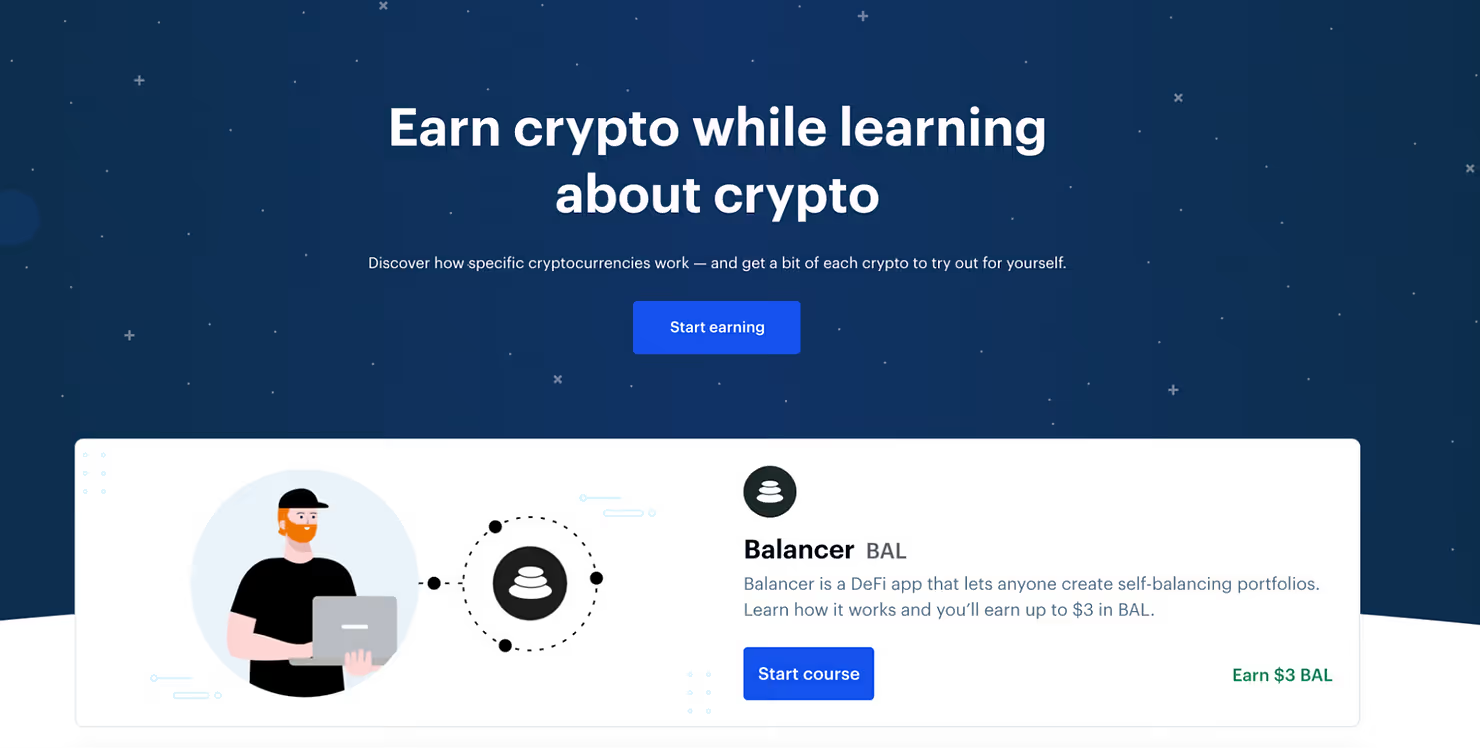
Coinbase is one of crypto’s most widely used and trusted crypto exchanges. One aspect of their onboarding is the opportunity to earn crypto by learning about individual crypto currencies through their course videos. You get paid in the relevant cryptocurrency and can have it deposited directly into your coinbase wallet, at which point you can transfer or do whatever you want with it.

Their video courses cover a variety of cryptocurrencies including:

  1. Clover Finance
  2. The Graph
  3. BarnBridge
  4. AMP
  5. Stellar Lumens
  6. Compound
  7. Balancer
  8. Ampleforth Governance Token

And many more.

You can earn more than $50+ in various cryptocurrencies, so the payout is really good, but it’s ultimately a finite source. There are only so many videos, so you take a few hours, get your crypto, and get out.

If you’re new to crypto, the education is worth watching either way. It’s a complicated sector, and starting slowly and with an education-first mindset is the best way to prevent poor investments.

Try Coinbase Learning Center

Coinmarket Cap Learning Center

WikiBuy vs Honey

Another option that functions in a similar way to Coinbase is the Coinmarket Cap Learning Center. Coinmarketcap has different videos and requires you to take a short quiz afterward, but the payouts and educational value are also high.

Here are some of the courses they offer:

  1. Toko Token
  2. IoTex
  3. SushiSwap
  4. Polkastarter
  5. Plasma Finance

As you’re going through these, try and see which tokens you think have the most potential. These courses are essentially ads and pitches, after all. If one seems particularly promising, you could bankall of the coins you earn from these courses and trade them for the one or few cryptocurrencies you think are most promising.

Try CoinmarketCap Learning Center

Odysee

WikiBuy vs Honey

Odysee is positioned as an answer to Youtube’s and other major information platforms’ censorship and aims to be a decentralized educational and content resource.

Creators can post their videos on Odysee without any fear of censorship, and users can earn LBRY, their token, by watching and interacting with videos. When you watch a video on Odysee, both you and the creator earn crypto. This rewards you for your data and engagement while encouraging creators to continue to release videos on Odysee.

Whether or not earning cryptocurrency on Odysee is worth your time partly depends on if you believe in the LBRY crypto itself.

This is their mission:

First and foremost, LBRY is a new protocol that allows anyone to build apps that interact with digital content on the LBRY network. Apps built using the protocol allow creators to upload their work to the LBRY network of hosts (like BitTorrent), to set a price per stream or download (like iTunes) or give it away for free (like YouTube without ads). The work you publish could be videos, audio files, documents, or any other type of file.

If you think something like LBRY could compete with (or work alongside) a service like Spotify to enable artists to earn more from their music, this could be an interesting choice.

Earn Crypto With Odysee

Permission

WikiBuy vs Honey

Permission.’s mission is to give data ownership back to the people. Broadly speaking, this means rewarding you with crypto for any online interaction that involves your data. It’s your data, after all, and if companies want to use it, they should pay you for it.

We’re just getting started with our Web 3.0 revolution, but one example of our mission in practice is our Permission.io browser extension.

The Permission.io browser extension helps you earn cryptocurrency as you surf the web. After you install the extension on Chrome, if you search for something and a relevant video ad is available, we notify you of the option to earn for interacting with that video.

For example, if you were into skateboarding and typed “new skateboards,” and a rewarded ad featuring a skateboarding apparel or board company is available, you could be notified with a video ad that essentially says, “Hey we make skateboards. Wanna check it out?” And then if you do, you earn $ASK crypto for watching the video and even more if you end up buying the board from them.

And the best part? You don’t have to change any of your existing habits. They’re non-intrusive, opt-in ads.

PlayNano Online
WikiBuy vs Honey

While somewhat polarizing due to its price and relationship to the BitGrail $195 Million hack, the Nano community is vibrant, enthusiastic, and has created many ways to earn Nano.

Nano is aimed at being a decentralized currency and hopes to eliminate middlemen that charge transaction fees and tack on other hidden costs. Imagine instant wire transfers between countries for free — that’s the type of world Nano is aiming to build.

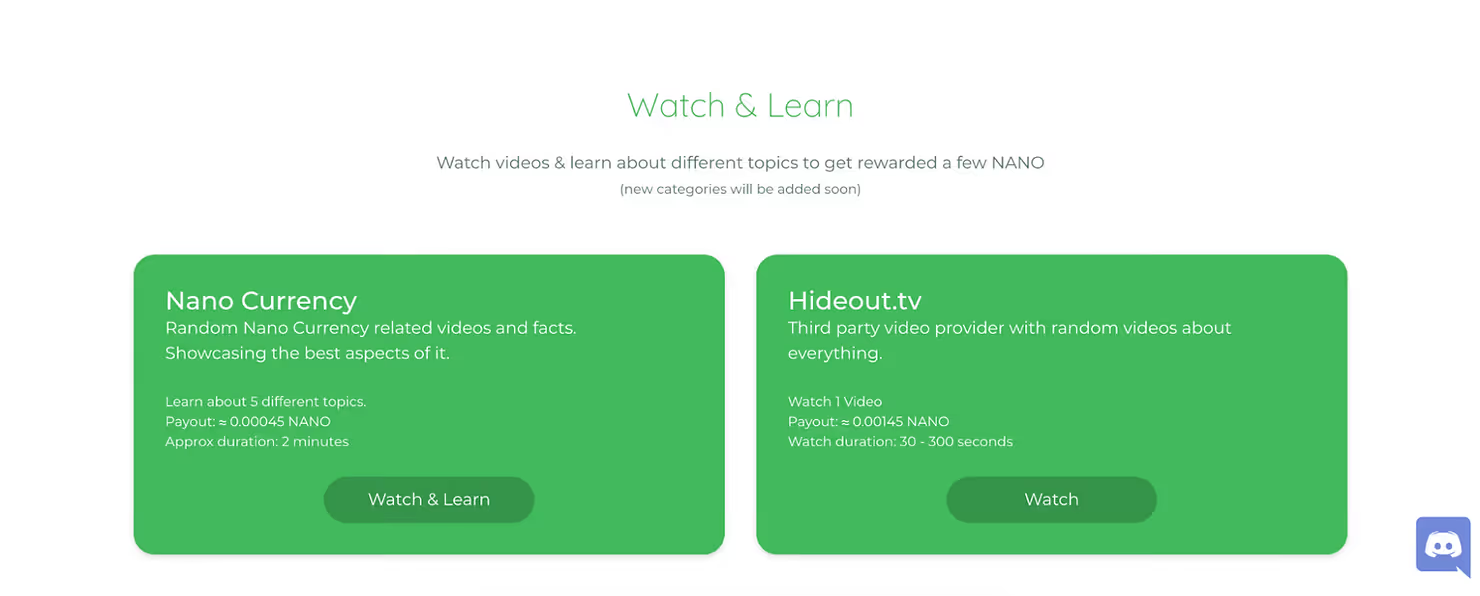
PlayNano, specifically, is a project that lets you earn Nano by watching videos, playing games, completing surveys, and other activities.

Like the other options here, it depends on how much you believe in Nano, but if you do, then this is definitely a good option.

Earn Crypto With PlayNano

The bottom line on earning cryptocurrency by watching videos

With the exclusion of a few companies like the online exchange courses and Permission.io browser extension, earning cryptocurrency by watching videos isn’t a smooth landscape yet. Most of the payouts are very low, and you are still subject to the whims of the crypto market.

These are the best options we know of, but you should still do your research, see which cryptocurrencies you think have the best chance of succeeding, and spend your time watching videos that let you earn those currencies.

Recent articles

Your ASK Wallet, Now Powered by Coinbase

Sep 22nd, 2026
|
{time} read time

We've partnered with Coinbase to bring best-in-class wallet technology to our community.

Today we're updating the technology that powers your ASK wallet. Here's what's changing, what it means for you, and what stays exactly the same.

What's changing

We've moved your Permission wallet to Coinbase's platform. What that means in plain language is this: starting today, you are in full control of your ASK. When you click to send, redeem, or manage your balance, the transaction happens from your account, signed by your login. We no longer hold your wallet keys. Coinbase does, on your behalf, under your authority.

We chose Coinbase's embedded wallet specifically because it brings institutional-grade security to our users without requiring you to manage anything yourself. The infrastructure is Coinbase's. The wallet is yours.

Beyond the custody change, our users now have a wallet that can go wherever they go: exportable, cross-chain ready, and backed by a platform that serves millions of people around the world. We're proud to bring that to our community.

What it means to control your own keys

As Permission has grown, we felt strongly that your funds should be held by a platform built specifically for that purpose, with the security standards and regulatory rigor that come with it. Moving to Coinbase's embedded wallet reflects that commitment.

With today's change, Coinbase secures your private key inside their systems, and only your Permission login can authorize transactions. When you click to send or redeem ASK, the transaction is authorized by you, through your login. We are no longer part of that process.

What this means practically: your wallet operates on its own, independent of Permission. Treat your Permission login like you would a bank password. It is now the key to your wallet. If you ever want to take your wallet entirely outside of Permission, Coinbase supports key export and that option is yours.

What Coinbase sees

Because Coinbase is now part of the infrastructure, your email address, account identifier, and wallet information are shared with them for the purpose of operating the wallet. For details on how Coinbase handles this data, you can review their embedded wallet documentation and their privacy information.

For how Permission handles your data, our Terms of Use and our Privacy Policy govern that relationship, as they always have.

What stays the same

Everything you experience in the app. Earning ASK, redeeming it, transferring it, viewing your balance, managing your family. None of that changes.

And, what does change, we're excited about: key export, cross-chain support, and institutional-grade security. These are capabilities that would have taken years to build in-house and that Coinbase has spent that time perfecting. We chose to partner with the best-in-class, and our product and users will be better for it.

If you have questions, support is always here.

The Permission Team 🤝

What Is Family Friendly AI™?

Sep 9th, 2026
|
{time} read time

Only 15% of people globally say they trust AI systems, and 72% of parents are concerned about AI’s impact on their children.

AI is quickly becoming part of everyday family life, but Big Tech wasn’t built with families in mind. Family Friendly AI is technology intentionally designed for families, giving parents visibility into their children’s digital lives, guidance when they need it, and tools to encourage positive behavior.

5 Things That Make AI Family Friendly

1. Your family owns its data.

‍Your family’s data is never sold. It belongs to your family, and you stay in control of it.

2. Parents know what’s happening online.

‍Family Friendly AI gives parents visibility into their children’s digital lives, helping them fully understand how their children use and interact with technology.

3. It motivates children with rewards and incentives.

‍Parents can set rewards and incentives to encourage positive behaviors and help their children build better habits around technology and beyond.

4. It gives parents coaching and inspiration.

‍Parenting in a digital world comes with challenges that screen-time limits alone can’t help with. Family Friendly AI gives parents personalized AI-insights and guidance to help them navigate what their children are doing online and decide what to do next.

5. It earns families' trust.

‍Technology for families should have a higher bar. The companies building it should stand behind it with an unconditional, no-questions-asked money-back guarantee.

It’s time for AI, crypto, and the technology shaping our children’s lives to meet the family-friendly standard.

Big Tobacco Had Its Reckoning. Now It’s Big Tech’s Turn.

Aug 12th, 2026
|
{time} read time

The floodgates are open.

Thousands of lawsuits are moving forward. States are writing new rules for kids online. And lawmakers are beginning to tell AI companies what they can and cannot do when children use their products.

And you don't have to look far to see it happening...

The courts: 3,000+ lawsuits get the green light

On August 10, the Ninth Circuit allowed more than 3,000 lawsuits against Meta, Google/YouTube, TikTok and Snap to move forward.

The cases allege that the companies deliberately designed features of their platforms to be addictive, particularly for young users.

The tech companies had argued that Section 230 of the Communications Decency Act protected them from the claims. The court rejected their attempt to use Section 230 to stop the litigation at this stage, finding that it provides a defense rather than immunity from being sued.

At their core, these cases are allegations about the platforms themselves: how they were designed, how they kept people engaged, and what responsibility the companies bear for the consequences.

The companies will still have the opportunity to defend themselves against those allegations.

But with more than 3,000 cases now getting the chance to be heard, this is getting harder to argue away.

New Jersey: families get a way to enforce the rules

One day later, New Jersey Governor Mikie Sherrill signed the New Jersey Kids Code Act into law.

The law establishes new design and privacy requirements for covered online services likely to be accessed by minors. Among other provisions, it requires high privacy settings by default, restricts certain push notifications, prohibits dark patterns for minors, limits how children's personal data can be used and retained, and places restrictions on targeted advertising.

But one provision in particular changes the accountability equation: a private right of action.

An individual under 18 who is injured by a violation can bring a claim under the law, with statutory damages of $5,000 per violation. Parents may also bring an action on a minor's behalf.

Which is legal language for something pretty simple: families don't have to wait around for a regulator to act. They can take companies to court themselves.

Colorado: AI safety starts becoming a legal requirement

Then there's Colorado.

Earlier this year, Governor Jared Polis signed Colorado HB 26-1263, establishing specific requirements for operators of conversational AI services.

And this one is worth paying attention to because the law doesn't simply tell AI companies to "keep kids safe." It starts defining what that actually means.

Operators must estimate users' ages. When dealing with minors, the law requires recurring disclosures that they are interacting with AI rather than a person and establishes protections around sexually explicit interactions.

It also addresses one of the most unsettling questions surrounding companion-style AI: emotional dependence.

The law requires safeguards designed to prevent conversational AI from producing statements that simulate emotional dependence. It also requires protocols for responding to suicidal ideation and self-harm, privacy and account-management tools for minors and parents or guardians, and reporting requirements intended to help regulators evaluate whether those safeguards are actually working.

The law takes effect January 1, 2027.

For companies building conversational AI, that's a meaningful shift. Child safety is moving beyond a set of voluntary guardrails companies write for themselves. In Colorado, some of those guardrails are becoming law.

It's no coincidence that this is all happening at once.

Big Tobacco didn't wake up one morning and discover the world had changed its mind. The reckoning came piece by piece, until lawsuits became regulation and an industry that had spent decades setting its own standards was finally forced to take responsibility for the harm its products caused.

We're watching that shift happen again.

For years, the responsibility for keeping kids safe online has fallen on parents.

Set the parental controls. Check the privacy settings. Watch the screen time. Know which apps they're using. Figure out who they're talking to. Keep up with every new platform, algorithm and now AI chatbot entering their lives.

All while the technology on the other side of the screen gets more sophisticated by the month.

Now courts and lawmakers are starting to ask the companies building that technology a much more uncomfortable question:

If children are using your products, what are you doing to keep them safe?

For families, that's the shift that matters most.

This isn't another round of false promises to "do better."

This is legislation. These are lawsuits. This is accountability beginning to have teeth.

Parents will always have the role of protecting their children online. We happen to believe they should have far more visibility and control over the technology entering their families' lives, not less.

But parents cannot be the entire safety system.

The law is making clear that the companies designing the products, writing the algorithms and building the AI our kids interact with have a responsibility, too.

And when they fail to meet it, they'll finally be held accountable.

ChatGPTs Births A Parenting Tool That Needs Some Image Repair

Aug 4th, 2026
|
{time} read time

Sam Altman keeps pitching AI as a co-parent. The reason parents aren't buying isn't nostalgia, it's the lawsuits.

Last Friday, Sam Altman had an idea he was excited about. Hook your family calendar up to ChatGPT, tell it what your kids are into, and every morning on the drive to school it'll produce a little podcast: one kid's soccer game that afternoon, another kid's birthday coming up, maybe some news. He called it a "cool use case."

What should’ve felt really innovative, landed like the opening scene of a bleak dystopian movie. Two kids in the back, one parent up front, and a smooth synthetic voice narrating, to everyone present, the lives of everyone present. "Later today, Maya has soccer." Maya, who has soccer, looks out the window. Nobody says anything, because the podcast is saying it for them.

The internet population caught what we caught. The reply that stuck came from Alex Hirsch, creator of Disney’s Animated series, Gravity Falls. It was seven poignant words: "What if you just talked to your children?" That was the entire rebuttal, and it traveled a great deal further than the thing it was rebutting. Altman's post drew somewhere around 9,600 likes. Hirsch's reply cleared 120,000. On the CEO's own platform, the crowd took a vote, and the crowd chose the small talk.

Now, we want to be fair here, because the easy thing is to dunk and move on. But we’re parents here at Permission and anyone who has done the 7:40 a.m. drive on four hours of sleep, refereeing a backseat dispute about who touched whom first, knows the exact fantasy of a button that handles the morning. That instinct isn't a character flaw. It's a Tuesday.

But this wasn't a one-off. Altman has been quietly auditioning AI for the co-parent role for a while now. On The Tonight Show in December 2025 he said he couldn't imagine having to "raise a newborn without ChatGPT" then added that people had managed the trick for a few hundred thousand years without it. Also, last year, in a podcast hosted by Andrew Mayne, Altman admitted that people might form “problematic parasocial relationships” to a chatbot. (You know, the one-sided kind that we usually reserve for celebrities we've never met.) He sees the hazards clearly. He's pitching the product anyway.

When visibility turns into vulnerability.

The reason parents flinched at the idea of carpooling with a chatbot for school drop off isn't that they're allergic to convenience. It's that the company making the offer is, right now, being sued by multiple families who say its chatbot played a role in their loved ones' spiraling delusions and, in the worst cases, their deaths. OpenAI says it is continually improving how its models handle sensitive conversations, and that work genuinely matters. But you can see the problem. "Let me into your calendar, your commute, and your kids personal details" is a big ask from anyone. It is a much bigger ask from a company currently explaining itself in court.

Trust isn't a feature you ship in the next update. It's something people hand you slowly, and take back all at once.

Here's where we should admit an interest. We build Permission on a belief that sounds boring until you sit with it: your data belongs to you. With Permission your kids’ browsing history doesn’t get shipped out to the open internet. Not to a model, not to a growth chart, not to whoever posts the next cool use case. And the closer AI creeps toward our kids (and it is creeping, because kids are already asking it everything) the more one question starts to outrank all the others:

Where is the line between parenting and outsourcing parenting?

Because "parenting tool" is doing a lot of quiet work in that phrase. A tool is a hammer. It lives in a drawer, it does one honest thing, and it does not ask to read your child's messages or move into the family calendar. When a company calls its chatbot a "parenting tool," it's worth asking, gently, which word they mean. The tool part, or the parenting part.

We happen to think AI can be genuinely, unglamorously useful to families. Not by doing the talking for you, but by handing you the context you'd otherwise miss instead of a thousand panicked notifications, and then getting out of the way so you can make the call. That's a real distinction, and it deserves its own piece.

So take this as Part One: the news, the flinch, and the reason the flinch is earned. In Part Two, we'll make the harder and more hopeful argument that you can let AI help you parent without completely handing over your family secrets. There is a version of this where the grown-ups stay in charge. We think it's the only version worth building.

For now, the seven best words anyone has offered on the whole affair still belong to Hirsch. So we'll give him the last one, too.

What if you just talked to your children?

‍