Blog
Updates and insights on data ownership in the AI era — exploring how permission builds a safer, more transparent, and rewarding digital future.

Recent Articles
What Is Family Friendly AI™?
Only 15% of people globally say they trust AI systems, and 72% of parents are concerned about AI’s impact on their children.
AI is quickly becoming part of everyday family life, but Big Tech wasn’t built with families in mind. Family Friendly AI is technology intentionally designed for families, giving parents visibility into their children’s digital lives, guidance when they need it, and tools to encourage positive behavior.
5 Things That Make AI Family Friendly
1. Your family owns its data.
Your family’s data is never sold. It belongs to your family, and you stay in control of it.
2. Parents know what’s happening online.
Family Friendly AI gives parents visibility into their children’s digital lives, helping them fully understand how their children use and interact with technology.
3. It motivates children with rewards and incentives.
Parents can set rewards and incentives to encourage positive behaviors and help their children build better habits around technology and beyond.
4. It gives parents coaching and inspiration.
Parenting in a digital world comes with challenges that screen-time limits alone can’t help with. Family Friendly AI gives parents personalized AI-insights and guidance to help them navigate what their children are doing online and decide what to do next.
5. It earns families' trust.
Technology for families should have a higher bar. The companies building it should stand behind it with an unconditional, no-questions-asked money-back guarantee.
It’s time for AI, crypto, and the technology shaping our children’s lives to meet the family-friendly standard.
Big Tobacco Had Its Reckoning. Now It’s Big Tech’s Turn.
The floodgates are open.
Thousands of lawsuits are moving forward. States are writing new rules for kids online. And lawmakers are beginning to tell AI companies what they can and cannot do when children use their products.
And you don't have to look far to see it happening...
The courts: 3,000+ lawsuits get the green light
On August 10, the Ninth Circuit allowed more than 3,000 lawsuits against Meta, Google/YouTube, TikTok and Snap to move forward.
The cases allege that the companies deliberately designed features of their platforms to be addictive, particularly for young users.
The tech companies had argued that Section 230 of the Communications Decency Act protected them from the claims. The court rejected their attempt to use Section 230 to stop the litigation at this stage, finding that it provides a defense rather than immunity from being sued.
At their core, these cases are allegations about the platforms themselves: how they were designed, how they kept people engaged, and what responsibility the companies bear for the consequences.
The companies will still have the opportunity to defend themselves against those allegations.
But with more than 3,000 cases now getting the chance to be heard, this is getting harder to argue away.
New Jersey: families get a way to enforce the rules
One day later, New Jersey Governor Mikie Sherrill signed the New Jersey Kids Code Act into law.
The law establishes new design and privacy requirements for covered online services likely to be accessed by minors. Among other provisions, it requires high privacy settings by default, restricts certain push notifications, prohibits dark patterns for minors, limits how children's personal data can be used and retained, and places restrictions on targeted advertising.
But one provision in particular changes the accountability equation: a private right of action.
An individual under 18 who is injured by a violation can bring a claim under the law, with statutory damages of $5,000 per violation. Parents may also bring an action on a minor's behalf.
Which is legal language for something pretty simple: families don't have to wait around for a regulator to act. They can take companies to court themselves.
Colorado: AI safety starts becoming a legal requirement
Then there's Colorado.
Earlier this year, Governor Jared Polis signed Colorado HB 26-1263, establishing specific requirements for operators of conversational AI services.
And this one is worth paying attention to because the law doesn't simply tell AI companies to "keep kids safe." It starts defining what that actually means.
Operators must estimate users' ages. When dealing with minors, the law requires recurring disclosures that they are interacting with AI rather than a person and establishes protections around sexually explicit interactions.
It also addresses one of the most unsettling questions surrounding companion-style AI: emotional dependence.
The law requires safeguards designed to prevent conversational AI from producing statements that simulate emotional dependence. It also requires protocols for responding to suicidal ideation and self-harm, privacy and account-management tools for minors and parents or guardians, and reporting requirements intended to help regulators evaluate whether those safeguards are actually working.
The law takes effect January 1, 2027.
For companies building conversational AI, that's a meaningful shift. Child safety is moving beyond a set of voluntary guardrails companies write for themselves. In Colorado, some of those guardrails are becoming law.
It's no coincidence that this is all happening at once.
Big Tobacco didn't wake up one morning and discover the world had changed its mind. The reckoning came piece by piece, until lawsuits became regulation and an industry that had spent decades setting its own standards was finally forced to take responsibility for the harm its products caused.
We're watching that shift happen again.
For years, the responsibility for keeping kids safe online has fallen on parents.
Set the parental controls. Check the privacy settings. Watch the screen time. Know which apps they're using. Figure out who they're talking to. Keep up with every new platform, algorithm and now AI chatbot entering their lives.
All while the technology on the other side of the screen gets more sophisticated by the month.
Now courts and lawmakers are starting to ask the companies building that technology a much more uncomfortable question:
If children are using your products, what are you doing to keep them safe?
For families, that's the shift that matters most.
This isn't another round of false promises to "do better."
This is legislation. These are lawsuits. This is accountability beginning to have teeth.
Parents will always have the role of protecting their children online. We happen to believe they should have far more visibility and control over the technology entering their families' lives, not less.
But parents cannot be the entire safety system.
The law is making clear that the companies designing the products, writing the algorithms and building the AI our kids interact with have a responsibility, too.
And when they fail to meet it, they'll finally be held accountable.
ChatGPTs Births A Parenting Tool That Needs Some Image Repair
Sam Altman keeps pitching AI as a co-parent. The reason parents aren't buying isn't nostalgia, it's the lawsuits.
Last Friday, Sam Altman had an idea he was excited about. Hook your family calendar up to ChatGPT, tell it what your kids are into, and every morning on the drive to school it'll produce a little podcast: one kid's soccer game that afternoon, another kid's birthday coming up, maybe some news. He called it a "cool use case."
What should’ve felt really innovative, landed like the opening scene of a bleak dystopian movie. Two kids in the back, one parent up front, and a smooth synthetic voice narrating, to everyone present, the lives of everyone present. "Later today, Maya has soccer." Maya, who has soccer, looks out the window. Nobody says anything, because the podcast is saying it for them.
The internet population caught what we caught. The reply that stuck came from Alex Hirsch, creator of Disney’s Animated series, Gravity Falls. It was seven poignant words: "What if you just talked to your children?" That was the entire rebuttal, and it traveled a great deal further than the thing it was rebutting. Altman's post drew somewhere around 9,600 likes. Hirsch's reply cleared 120,000. On the CEO's own platform, the crowd took a vote, and the crowd chose the small talk.
Now, we want to be fair here, because the easy thing is to dunk and move on. But we’re parents here at Permission and anyone who has done the 7:40 a.m. drive on four hours of sleep, refereeing a backseat dispute about who touched whom first, knows the exact fantasy of a button that handles the morning. That instinct isn't a character flaw. It's a Tuesday.
But this wasn't a one-off. Altman has been quietly auditioning AI for the co-parent role for a while now. On The Tonight Show in December 2025 he said he couldn't imagine having to "raise a newborn without ChatGPT" then added that people had managed the trick for a few hundred thousand years without it. Also, last year, in a podcast hosted by Andrew Mayne, Altman admitted that people might form “problematic parasocial relationships” to a chatbot. (You know, the one-sided kind that we usually reserve for celebrities we've never met.) He sees the hazards clearly. He's pitching the product anyway.
When visibility turns into vulnerability.
The reason parents flinched at the idea of carpooling with a chatbot for school drop off isn't that they're allergic to convenience. It's that the company making the offer is, right now, being sued by multiple families who say its chatbot played a role in their loved ones' spiraling delusions and, in the worst cases, their deaths. OpenAI says it is continually improving how its models handle sensitive conversations, and that work genuinely matters. But you can see the problem. "Let me into your calendar, your commute, and your kids personal details" is a big ask from anyone. It is a much bigger ask from a company currently explaining itself in court.
Trust isn't a feature you ship in the next update. It's something people hand you slowly, and take back all at once.
Here's where we should admit an interest. We build Permission on a belief that sounds boring until you sit with it: your data belongs to you. With Permission your kids’ browsing history doesn’t get shipped out to the open internet. Not to a model, not to a growth chart, not to whoever posts the next cool use case. And the closer AI creeps toward our kids (and it is creeping, because kids are already asking it everything) the more one question starts to outrank all the others:
Where is the line between parenting and outsourcing parenting?
Because "parenting tool" is doing a lot of quiet work in that phrase. A tool is a hammer. It lives in a drawer, it does one honest thing, and it does not ask to read your child's messages or move into the family calendar. When a company calls its chatbot a "parenting tool," it's worth asking, gently, which word they mean. The tool part, or the parenting part.
We happen to think AI can be genuinely, unglamorously useful to families. Not by doing the talking for you, but by handing you the context you'd otherwise miss instead of a thousand panicked notifications, and then getting out of the way so you can make the call. That's a real distinction, and it deserves its own piece.
So take this as Part One: the news, the flinch, and the reason the flinch is earned. In Part Two, we'll make the harder and more hopeful argument that you can let AI help you parent without completely handing over your family secrets. There is a version of this where the grown-ups stay in charge. We think it's the only version worth building.
For now, the seven best words anyone has offered on the whole affair still belong to Hirsch. So we'll give him the last one, too.
What if you just talked to your children?
The Verdicts Are In
For years, concerns about the harm social media platforms cause children were categorized as “alleged.” In the spring of 2026, juries started using different words: negligent, deceptive, unconscionable. Courts are now saying what parents have long suspected: the design was the harm. Here is what the courtroom evidence now shows and why parents should be paying close attention.
Before a Child Can Tell Fact From Fiction
Before children are developmentally equipped to distinguish fact from fiction, digital systems have already begun influencing how they think, what captures their attention, and how they begin forming their sense of identity.
Social media platforms no longer function as just communication tools today. They increasingly shape how children develop self-worth, regulate emotion, build social relationships, and understand the world around them.
For years, concerns surrounding children’s relationship with technology were often dismissed as parental anxiety or treated as speculation. That argument is becoming harder to sustain.
Across courtrooms, regulatory investigations, internal company disclosures, and mounting scientific research, a clear pattern is emerging: some of the world’s largest technology companies have built systems that maximize engagement by exploiting psychological vulnerabilities in young users, while parents remain largely unaware of what they have actually consented to.
The issue is no longer whether these systems pose risks to children.
The more urgent question is whether the systems themselves will fundamentally change, or whether society will continue documenting the damage in real time while continuing to participate in the very system that creates it.
The Environment Around Childhood Has Changed
The environment children grow up in has changed.
- Up to 95% of teens aged 13–17 report using a social platform, and more than a third say they use it "almost constantly."
- Nearly 40% of children aged 8–12 are already using social media — below the age most platforms claim to serve.
- Use exceeding about three hours a day has been associated with elevated anxiety, depression, suicidal ideation and body-image distress.
Why are children so easily targeted by these platforms? In adolescence, the regions that govern judgment and emotional steadiness are still maturing, while those that respond to approval, comparison, and reward are already highly active. These platforms are designed to pull on exactly those urges - through likes, notifications, feeds that never end, and "recommended for you" videos that keep coming.
The American Psychological Association has warned that this combination leaves minors more prone to compulsive use, and more exposed to the emotional toll of measuring themselves by how others react to them online.
As reported in Parenting in the Age of AI: Why Tech Is Making Parenting Harder — and What Parents Can Do, parenting got harder because the environment has shifted.
For the first time, families are raising children inside digital environments designed to maximize engagement and continuously compete for attention. Traditional parenting tools now operate against these systems that are created to keep children online for as long as possible.
What many parents experience as daily frustration is often not a parenting challenge. It is the result of an environment intentionally optimized to override the limits parents try to set.
What the Lawsuits Prove
For years, the harm caused by digital platforms was “alleged.”
That is changing rapidly.
Between 2024 and 2026, a series of major lawsuits against companies including Meta, TikTok, Google, Character.AI and OpenAI have moved beyond accusation and into courtrooms where evidence is now being publicly examined.
These lawsuits all share something important: they don't blame a single video or post for harming a child. They blame how the apps themselves are built — the endless scroll, the recommendations that decide what your child sees next, the AI designed to keep them watching.
For years, companies argued they couldn't be held responsible for what users posted on their platforms. These cases now point to the design itself, the features built to capture and hold a child's attention. Courts are now increasingly letting those claims move forward.
- K.G.M. v. Meta & Google/YouTube
- State of New Mexico v. Meta
- Anderson v. TikTok
- United States v. TikTok & ByteDance
- Garcia v. Character Technologies
- State of Florida v. OpenAI & Sam Altman
The courts, claims, design features and outcomes are laid out in Appendix A.
The Pattern
Across nearly every major lawsuit involving child safety and digital platforms, an alarming pattern continues to repeat itself.
- Internal research identifies harm early.
- Executives are made aware of developmental, psychological, and behavioral risks to minors.
- Product teams continue implementing design choices that increase engagement despite those findings.
- Public messaging continues emphasizing safety while internal evidence often tells a different story.
Only after years of public pressure do regulators or courts intervene.
When growth and user wellbeing compete, technology companies have repeatedly demonstrated which one wins. While accountability has almost always arrived only after harm has already occurred.
The Consent Parents Never Gave
At the center of nearly every child safety dispute in technology sits a deeper issue that receives far less attention: consent.
Modern internet platforms operate under the assumption that consent has been obtained simply because a user clicked “I agree.”
But clicking “I agree” was never meaningful consent.
Meaningful consent requires understanding consequences.
Yet most parents are never clearly told:
- How algorithms shape what children see.
- How behavioral data is continuously collected and analyzed.
- How engagement systems are designed around psychological reward loops.
- How platforms measure emotional responses, attention patterns, and behavioral tendencies to optimize retention.
- How artificial intelligence systems increasingly personalize influence in ways families cannot see.
Parents were never fully informed about the environments their children were entering.
Will Anything Change?
What gets accepted today becomes the default tomorrow.
The risks, the design choices and the outcomes are now well documented.
Much of what happens next will be shaped by a series of major bellwether cases already underway. The 2026 verdicts in K.G.M. v. Meta and State of New Mexico v. Meta were early signals.
Federal litigation is now accelerating through MDL 3047, where more than 2,600 cases against major tech companies have been consolidated, with the first federal bellwether trial beginning in June 2026.
The outcomes of these cases will help define the future relationship between families and technology.
At Permission, we closely monitor this litigation because it keeps returning to the same core truth: parents deserve to know what their children are actually consenting to — and children deserve to grow up in environments designed to support their development, not exploit their vulnerabilities.
Parents deserve to understand these environments while they are still evolving, not years later, after the consequences are already visible. And children deserve to grow up in environments designed to support their development, not exploit their vulnerabilities.
Learn more about why AI needs permission (and what it means for your family) at AI needs Permission. Permission is actively tracking this litigation and the broader shift it represents for families, AI, and the future of consent online.
Share Permission. Help Another Family.
There's something that happens when Permission starts working for your family. You notice things earlier. Conversations get easier. The guesswork goes away.
And almost immediately, you think of another family who needs this.
Now there's a simple way to share it — and get rewarded when you do.
How It Works
Refer Permission to other parents. When three families subscribe through your unique referral link, you receive a $30 gift card — automatically, with no limit on how many times you can earn.**
It's straightforward:
- Get your unique referral link from your Permission account
- Share it with parents you think would benefit
- Once three families subscribe to a paid plan, your $30 gift card is on its way
That's it. No complicated tiers. No tracking spreadsheets. Just sharing something you believe in and being rewarded for it.
.avif)
A Few Things to Know
- Rewards are triggered by completed paid subscriptions — free trials don't count.
- You'll receive a notification once your reward has been credited.
- Gift cards are fulfilled via our rewards partner, Tremendous. Redemption availability may vary.
- When sharing your referral link, please disclose that you may receive a reward if the person you refer subscribes. Example: "I use Permission and earn rewards when friends sign up through my link."
- Program terms apply. See our Terms of Use for full details.
Why We Built This
Permission works best when it spreads the way trust does — through people who know each other.
Parents talk. They share what's working and what isn't. They ask each other for recommendations on everything from pediatricians to schools to apps. We'd rather reward that natural word-of-mouth than spend that money on ads.
When you refer a family to Permission, you're not just earning a gift card. You're helping another parent feel less alone in navigating their child's digital life.
Ready to Share?
Get your referral link → https://app.permission.ai/motivate
** Gift cards fulfilled via Tremendous. Referral rewards require completed paid subscriptions. Program terms apply. See Terms for full details.
What Every Parent Needs to Know Before Handing Over the iPad
Spring Break used to mean board games and bike rides.
Now it means 8+ hours a day on TikTok, Roblox, Snapchat.
Most kids are back in school now. But if you noticed something a little off this past week, you're not imagining it. If you're still bracing for the screentime fights, the "just five more minutes" negotiations, the device-at-dinner standoffs, you're not alone. But there's a better way to handle this than becoming the screentime police.
Here's what's actually happening on your kids' devices, and what you can do about it:
The honest truth: more free time = higher risk of social media addiction
During school breaks, kids average 3.5-4 extra hours of screen time per day.
That's not just YouTube and Minecraft. That's unstructured time on platforms that are designed by teams of engineers and behavioral psychologists to keep your child scrolling, clicking, and coming back.
In 2026, it's not just the amount that's shifted — since 2020, daily time on short-form video like TikTok and Reels has increased 14x for younger children.
This isn't an accident. A former Meta researcher described Instagram internally as "a drug." A YouTube internal document listed "viewer addiction" as a goal. A Meta employee even told colleagues: “We're basically pushers.”
Spring Break is one of the highest-risk weeks of the year for unsupervised screen use. More free time, less structure, and the same algorithms running 24 hours a day, messing with your children's attention around the clock.
What's actually happening on the platforms your kids use most
TikTok and Instagram use dopamine loops, short bursts of reward, to make scrolling feel impossible to stop. There is no natural endpoint. The algorithm learns what keeps your child watching and serves more of it, regardless of whether it's healthy. Landmark 2026 jury verdicts have recently found these platforms liable for intentionally designing addictive features that contribute to depression and anxiety in minors.
Roblox and Discord are where a lot of the real danger hides. Unmoderated voice chat, private group invitations, and off-platform contact attempts are common. Predators use these platforms specifically because parents underestimate them. Current multidistrict litigation (MDL 3166) alleges that these companies have failed to implement basic safeguards to prevent the grooming and exploitation of children.
Character.ai and ChatGPT don't verify ages. Kids as young as 8 are forming emotional attachments to AI companions, sharing things they'd never tell a parent or friend. There is no guardrail on what those conversations become. Recent wrongful death lawsuits highlight cases where minors engaged in harmful, obsessive relationships with AI, leading to tragic outcomes.
Snapchat was built around disappearing content, which means disappearing evidence. AI nudification tools are now accessible to teenagers directly through third-party apps that connect to Snapchat. State Attorneys General in Texas and New Mexico have filed suits alleging the platform is a "marketplace for predators" and facilitates the spread of non-consensual deepfake material.
This isn't about scaring you. It's about making sure you're not the last to know.
Stop being the screentime police. Become their coach instead.
Here's the shift that actually works.
The screentime police approach, counting minutes, setting timers, fighting nightly, doesn't build safe habits. It builds resentment. And the moment your kid is out from under your roof, those habits disappear entirely.
The better approach is mentorship. Think about how a great coach works. They don't bench their best player for making a mistake. They show them what went wrong, explain why it matters, and help them do better next time. That's what your kid needs from you on digital safety.
That means shifting from how long they're on a device to what they're seeing and whether they know how to handle it. A 15-minute conversation about what to do when a stranger DMs them on Discord is worth more than a screentime timer.
You don't need to be a tech expert to have that conversation. You just need the right information and the right words.
Three things to do this week (that aren't "take the phone away")
- Know which platforms they're actually using. Ask your kid to show you their five most-used apps. Don't make it an interrogation, make it curious. "What's this one? What do you do on it?" You'll learn more in five minutes than any parental control software will tell you.
- Have one real conversation, not ten small arguments. Pick a moment when you're both relaxed, not when you're already frustrated about screen time. Tell them what you know about how these platforms work. Not to lecture, to inform. Kids respond much better to "here's how TikTok is designed to keep you scrolling" than "put the phone down."
- Set expectations together, not rules from above. Ask your kid what they think fair looks like. You'll be surprised. Most kids actually have a sense of what's healthy, they just need permission to use it. Building the agreement together means they're far more likely to stick to it.
What your family values have to do with it
Every family is different. What's acceptable in one household isn't in another, and that's exactly how it should be.
The problem with most parental control tools is that they're built around a one-size-fits-all set of restrictions. Block this app. Limit that one. It creates friction, not understanding.
The better approach starts with your values. What do you actually care about for your kids? Safety, yes, but also independence, trust, and the skills they'll need when you're not there. The goal isn't to block everything. It's to raise a kid who makes good choices when you're not in the room.
Trusted AI for the Family. Built for Spring Break and beyond.
This is exactly why we built Permission AI for the Family.
It's not a parental control app. It's an AI that works with your family, surfacing what's actually happening on the platforms your kids use, giving you the scripts to have real conversations, and helping your kids build safe habits that last beyond Spring Break.
It's built around your values and your boundaries, not ours.
And right now, it's 100% free. That's a $240 annual value, at no cost.
If you've been meaning to get a better handle on your family's digital life, this is the week to do it.
Get Trusted AI for the Family — free at permission.ai/for-parents
Parenting In the Age of AI: Why Tech Is Making Parenting Harder – and What Parents Can Do
Many parents sense a shift in their children’s environment but can’t quite put their finger on it.
Children aren't just using technology. Conversations, friendships, and identity formation are increasingly taking place online - across platforms that most parents neither grew up with nor fully understand.
Many parents feel one step behind and question: How do I raise my child in a tech world that evolves faster than I can keep up with?
Why Parenting Feels Harder in the Digital Age
Technology today is not static. AI-driven and personalized platforms adapt faster than families can.
Parents want to raise their children to live healthy, grounded lives without becoming controlling or disconnected. Yet, many parents describe feeling:
- “Outpaced by the evolution of AI and Algorithms”
- “Disconnected from their children's digital lives”
- “Concerned about safety when AI becomes a companion”
- “Frustrated with insufficient traditional parental controls”
Research shows this shift clearly:
- 66% of parents say parenting is harder today than 20 years ago, citing technology as a key factor.
- Reddit discussions reveal how parents experience a “nostalgia gap,” in which their own childhoods do not resemble the digital worlds their children inhabit.
- 86% of parents set rules around screen use, yet only about 20% follow these rules consistently, highlighting ongoing tension in managing children’s device use.
Together, these findings suggest that while parents are trying to manage technology, the tools and strategies available to them haven’t kept pace with how fast digital environments evolve.
Technology has made parenting harder.
The Pressure Parents Face Managing Technology
Parents are repeatedly being told that managing their children's digital exposure is their responsibility.
The message is subtle but persistent: if something goes wrong, it’s because “you didn’t do enough.”
This gatekeeper role is an unreasonable expectation. Children’s online lives are always within reach, embedded in education, friendships, entertainment, and creativity. Expecting parents to take full control overlooks the reality of modern childhood, where digital life is constant and unavoidable.
This expectation often creates chronic emotional and somatic guilt for parents. At the same time, AI-driven platforms are continuously optimized to increase engagement in ways parents simply cannot realistically counter.
As licensed clinical social worker Stephen Hanmer D'Eliía explains in The Attention Wound: What the attention economy extracts and what the body cannot surrender, "the guilt is by design." Attention-driven systems are engineered to overstimulate users and erode self-regulation (for children and adults alike). Parents experience the same nervous-system overload as their kids, while lacking the benefit of growing up with these systems. These outcomes reflect system design, not parental neglect.
Ongoing Reddit threads confirm this reality. Parents describe feeling behind and uncertain about how to guide their children through digital environments they are still learning to understand themselves. These discussions highlight the emotional and cognitive toll that rapidly evolving technology places on families.
Parenting In A Digital World That Looks Nothing Like The One We Grew Up In
Many parents instinctively reach for their own childhoods as a reference point but quickly realize that comparison no longer works in today’s world. Adults remember life before smartphones; children born into constant digital stimulation have no such baseline.
Indeed, “we played outside all day” no longer reflects the reality of the world children are growing up in today. Playgrounds are now digital. Friendships, humor, and creativity increasingly unfold online.
This gap leaves parents feeling unqualified. Guidance feels harder when the environment is foreign, especially when society expects and insists you know how.

Children Are Relying on Chatbots for Emotional Support Over Parents
AI has crossed a threshold: from tool to companion.
Children are increasingly turning to chatbots for conversation and emotional support, often in private.
About one-in-ten parents with children ages 5-12 report that their children use AI chatbots like ChatGPT or Gemini. They ask personal questions, share worries, and seek guidance on topics they feel hesitant to discuss with adults.
Many parents fear that their child may rely on AI first instead of coming to them. Psychologists warn that this shift is significant because AI is designed to be endlessly available and instantly responsive (ParentMap, 2025).
Risks include:
- Exposure to misinformation.
- Emotional dependency on systems that can simulate care but cannot truly understand or respond responsibly.
- Blurred boundaries between human relationships and machine interaction.
Reporting suggests children are forming emotionally meaningful relationships with AI systems faster than families, schools, and safeguards can adapt (Guardian, 2025; After Babel, 2025b).
Unlike traditional tools, AI chatbots are built for constant availability and emotional responsiveness, which can blur boundaries for children still developing judgment and self-regulation — and may unintentionally mirror, amplify, or reinforce negative emotions instead of providing the perspective and limits that human relationships offer.
Why Traditional Parental Controls are Failing
Traditional parental controls were built for an “earlier internet,” one where parents could see and manage their children online. Today’s internet is algorithmic.
Algorithmic platforms bypass parental oversight by design. Interventions like removing screens or setting limits often increase conflict, secrecy, and addictive behaviors rather than teaching self-regulation or guiding children on how to navigate digital spaces safely (Pew Research, 2025; r/Parenting, 2025).
A 2021 JAMA Network study found video platforms popular with kids use algorithms to recommend content based on what keeps children engaged, rather than parental approval. Even when children start with neutral searches, the system can quickly surface videos or posts that are more exciting. These algorithms continuously adapt to a child’s behavior, creating personalized “rabbit holes” of content that change faster than any screen-time limit or parental control can manage.
Even the most widely used parental control tools illustrate this limitation in practice, focusing on:
- reacting after exposure (Bark)
- protecting against external risks (Aura)
- limiting access (Qustodio)
- tracking physical location (Life360)
What they largely miss is visibility into the algorithmic systems and personalized feeds that actively shape children’s digital experiences in real time.
A Better Approach to Parenting in the Digital Age
In a world where AI evolves faster than families can keep up, more restrictions won’t solve the disconnection between parents and children. Parents need tools and strategies that help them stay informed and engaged in environments they cannot fully see or control.
Some companies, like Permission, focus on translating digital activity into clear insights, helping parents notice patterns, understand context, and respond thoughtfully without prying.
Raising children in a world where AI moves faster than we can keep up is about staying present, understanding the systems shaping children’s digital lives, and strengthening the human connection that no algorithm can replicate.

What Parents Can Do in a Rapidly Changing Digital World
While no single tool or rule can solve these challenges, many parents ask what actually helps in practice.
Below are some of the most common questions parents raise — and approaches that research and lived experience suggest can make a difference.
Do parents need to fully understand every app, platform, or AI tool their child uses?
No. Trying to keep up with every platform or feature often increases stress without improving outcomes.
What matters more is understanding patterns: how digital use fits into a child’s routines, moods, sleep, and social life over time. Parents don’t need perfect visibility into everything their child does online; they need enough context to notice meaningful changes and respond thoughtfully.
What should parents think about AI tools and chatbots used by kids?
AI tools introduce a new dynamic because they are:
- always available
- highly responsive
- designed to simulate conversation and support
This matters because children may turn to these tools privately, for curiosity, comfort, or companionship. Rather than reacting only to the technology itself, parents benefit from understanding how and why their child is using AI, and having age-appropriate conversations about boundaries, trust, and reliance.
How can parents stay involved without constant monitoring or conflict?
Parents are most effective when they can:
- notice meaningful shifts early
- understand context before reacting
- talk through digital choices rather than enforce rules after the fact
This shifts digital parenting from surveillance to guidance. When children feel supported rather than watched, conversations tend to be more open, and conflict is reduced.
What kinds of tools actually support parents in this environment?
Tools that focus on insight rather than alerts, and patterns rather than isolated moments, are often more helpful than tools that simply report activity after something goes wrong.
Some approaches — including platforms like Permission — are designed to translate digital activity into understandable context, helping parents notice trends, ask better questions, and stay connected without hovering. The goal is to support parenting decisions, not replace them.
The Bigger Picture
Parenting in the age of AI isn’t about total control, and it isn’t about stepping back entirely.
It’s about helping kids:
- develop judgment
- understand digital influence
- build healthy habits
- stay grounded in human relationships
As technology continues to evolve, the most durable form of online safety comes from understanding, trust, and connection — not from trying to surveil or outpace every new system.
How You Earn with the Permission Agent
The Permission Agent was built to do more than sit in your browser.
It was designed to work for you: spotting opportunities, handling actions on your behalf, and making it super easy to earn rewards as part of your everyday internet use.
Here’s how earning works with the Permission Agent.
Earning Happens Through the Agent
Earning with Permission is powered by Agent-delivered actions designed to support the growth of the Permission ecosystem.
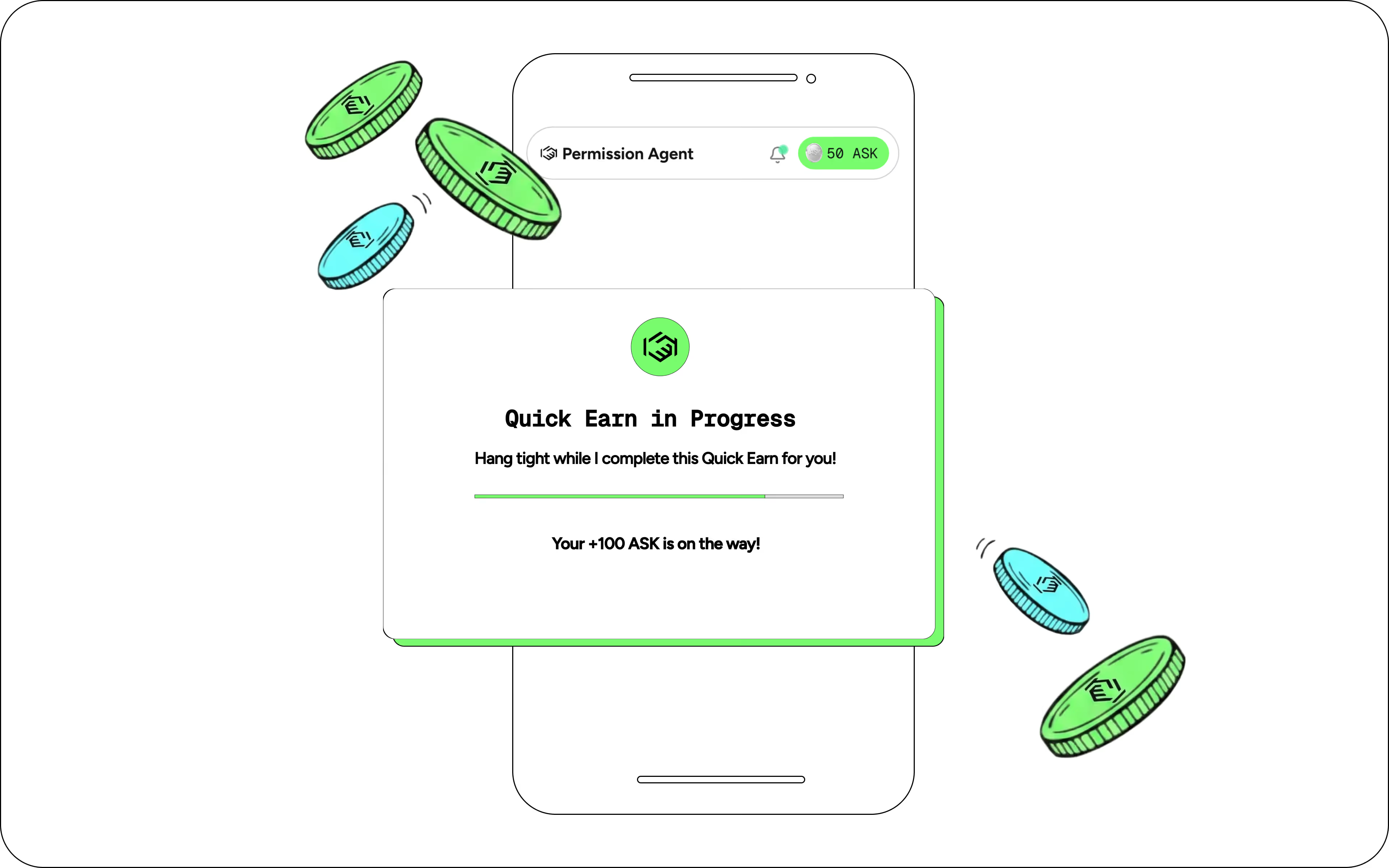
Rewards come through Rewarded Actions and Quick Earns, surfaced directly inside the Agent. When you use the Agent regularly, you’ll see clear, opt-in earning opportunities presented to you.
Importantly, earning is no longer based on passive browsing. Instead, opportunities are delivered intentionally through actions you choose to participate in, with rewards disclosed upfront.
You don’t need to search for offers or manage complex workflows. The Agent organizes opportunities and helps carry out the work for you.
Daily use is how you discover what’s available.
Rewarded Actions and Quick Earns
Rewarded Actions and Quick Earns are the primary ways users earn ASK through the Agent.
These opportunities may include:
- Supporting Permission launches and initiatives
- Participating in community programs or campaigns
- Sharing Permission through guided promotional actions
- Taking part in contests or time-bound promotions
All opportunities are presented clearly through the Agent, participation is always optional, and rewards are transparent.
The Agent Does the Work
What makes earning different with Permission is the Agent itself.
You choose which actions to participate in, and the Agent handles execution - reducing friction while keeping you in control. Instead of completing repetitive steps manually, the Agent performs guided tasks on your behalf, including mechanics behind promotions and referrals.
The result: earning ASK feels lightweight and natural because the Agent handles the busywork.
The more consistently you use the Agent, the more opportunities you’ll see.

Referrals and Lifetime Rewards
Referrals remain one of the most powerful ways to earn with Permission.
When you refer someone to Permission:
- You earn when they become active
- You continue earning as their activity grows
- You receive ongoing rewards tied to the value created by your referral network
As your referrals use the Permission Agent, it becomes easier for them to discover earning opportunities - and as they earn more, so do you.
Referral rewards operate independently of daily Agent actions, allowing you to build long-term, compounding value.
Learn more here:
👉 Unlock Rewards with the Permission Referral Program
What to Expect Over Time
As the Permission ecosystem grows, earning opportunities will expand.
You can expect:
- New Rewarded Actions and Quick Earns delivered through the Agent
- Campaigns tied to community growth and product launches
- Opportunities ranging from quick wins to more meaningful rewards
Checking in with your Agent regularly is the best way to stay up to date.
Getting Started
Getting started takes just a few minutes:
- Install the Permission Agent
- Sign in and activate it
- Use the Agent daily to see available Rewarded Actions and Quick Earns
From there, the Agent takes care of the rest - helping you participate, complete actions, and earn ASK over time.
Built for Intentional Participation
Earning with the Permission Agent is designed to be clear, intentional, and sustainable.
Rewards come from choosing to participate, using the Agent regularly, and contributing to the growth of the Permission ecosystem. The Agent makes that participation easy by handling the work - so value flows back to you without unnecessary effort.
2026: The Year of Disruption – Trust Becomes the Most Valuable Commodity
Moore’s Law is still at work, and in many ways it is accelerating.
AI capabilities, autonomous systems, and financial infrastructure are advancing faster than our institutions, norms, and governance frameworks can absorb. For that acceleration to benefit society at a corresponding rate, one thing must develop just as quickly: trust.
2026 will be the year of disruption across markets, government, higher education, and digital life itself. In every one of those domains, trust becomes the premium asset. Not brand trust. Not reputation alone. But verifiable, enforceable, system-level trust.
Here’s what that means in practice.
1. Trust Becomes Transactional, not Symbolic
Trust between agents won’t rely on branding or reputation alone. It will be built on verifiable exchange: who benefits, how value is measured, and whether compensation is enforceable. Trust becomes transparent, auditable, and machine-readable.
2. Agentic Agents Move from Novelty to Infrastructure
Autonomous, goal-driven AI agents will quietly become foundational internet infrastructure. They won’t look like apps or assistants. They will operate continuously, negotiating, executing, and learning across systems on behalf of humans and institutions.
The central challenge will be trust: whether these agents are acting in the interests of the humans, organizations, and societies they represent, and whether that behavior can be verified.
3. Agent-to-Agent Interactions Overtake Human-Initiated Ones
Most digital interactions in 2026 won’t start with a human click. They will start with one agent negotiating with another. Humans move upstream, setting intent and constraints, while agents handle execution. The internet becomes less conversational and more transactional by design.
4. Agent Economies Force Value Exchange to Build Trust
An economy of autonomous agents cannot run on extraction if trust is to exist.
In 2026, value exchange becomes mandatory, not as a monetization tactic, but as a trust-building mechanism. Agents that cannot compensate with money, tokens, or provable reciprocity will be rate-limited, distrusted, or blocked entirely.
“Free” access doesn’t scale in a defended, agent-native internet where trust must be earned, not assumed.
5. AI and Crypto Converge, with Ethereum as the Coordination Layer
AI needs identity, ownership, auditability, and value rails. Crypto provides all four. In 2026, the Ethereum ecosystem emerges as the coordination layer for intelligent systems exchanging value, not because of speculation, but because it solves real structural problems AI cannot solve alone.
6. Smart Contracts Evolve into Living Agreements
Static smart contracts won’t survive an agent-driven economy. In 2026, contracts become adaptive systems, renegotiated in real time as agents perform work, exchange data, and adjust outcomes. Law doesn’t disappear. It becomes dynamic, executable, and continuously enforced.
7. Wall Street Embraces Tokenization
By 2026, Wall Street fully embraces tokenization. Stocks, bonds, options, real estate interests, and other financial instruments move onto programmable rails.
This shift isn’t about ideology. It’s about efficiency, liquidity, and trust through transparency. Tokenization allows ownership, settlement, and compliance to be enforced at the system level rather than through layers of intermediaries.
8. AI-Driven Creative Destruction Accelerates
AI-driven disruption accelerates faster than institutions can adapt. Entire job categories vanish while new ones appear just as quickly.
The defining risk isn’t displacement. It’s erosion of trust in companies, labor markets, and social contracts that fail to keep pace with technological reality. Organizations that acknowledge disruption early retain trust. Those that deny it lose legitimacy.
9. Higher Education Restructures
Higher education undergoes structural change. A $250,000 investment in a four-year degree increasingly looks misaligned with economic reality. Companies begin to abandon degrees as a default requirement.
In their place, trust shifts toward social intelligence, ethics, adaptability, and demonstrated achievement. Proof of capability matters more than pedigree. Continuous learning matters more than static credentials.
Institutions that understand this transition retain relevance. Those that don’t lose trust, and students.
10. Governments Face Disruption From Systems They Don’t Control
AI doesn’t just disrupt industries. It disrupts governance itself. Agent networks ignore borders. AI evolves faster than regulation. Value flows escape traditional jurisdictional controls.
Governments face a fundamental choice: attempt to reassert control, or redesign systems around participation, verification, and trust. In 2026, adaptability becomes a governing advantage.
Conclusion
Moore’s Law hasn’t slowed. It has intensified. But technological acceleration without trust leads to instability, not progress.
2026 will be remembered as the year trust became the scarce asset across markets, government, education, and digital life.
The future isn’t human versus AI.
It’s trust-based systems versus everything else.
Raise Kids Who Understand Data Ownership, Digital Assets, and Online Safety
Online safety for kids has become more complex as AI systems, data tracking, and digital platforms increasingly shape what children see, learn, and engage with.
Parents today are navigating a digital world that looks very different from the one they grew up in.
Families Are Parenting in a World That Has Changed
Kids today don’t just grow up with technology. They grow up inside it.
They learn, socialize, explore identity, and build lifelong habits across apps, games, platforms, and AI-driven systems that operate continuously in the background. At the same time, parents face less visibility, more complexity, and fewer tools that genuinely support understanding without damaging trust.
For many families, this creates ongoing tension:
- conflict around screens
- uncertainty about what actually matters
- fear of missing something important
- a sense that digital life is moving faster than parenting tools have evolved
Research reflects this shift clearly:
- 81% of parents worry their children are being tracked online.
- 72% say AI has made parenting more stressful.
- 60% of teens report using AI tools their parents don’t fully understand.
The digital world has changed parenting. Families need support that reflects this new reality.
The Reality Families Are Facing Online
Online safety today involves far more than blocking content or limiting screen time.
Parents are navigating:
- Constant, multi-platform engagement, where behavior forms across apps, games, and feeds rather than in one place
- Early exposure to adult content, scams, manipulation, and persuasive design, often before kids understand intent or risk
- Mental health and sleep impacts, driven by routines and repetition rather than single moments
- AI-driven systems shaping what kids see, learn, buy, and interact with, often invisibly
- Social media dynamics, where likes, streaks, algorithms, and peer validation shape identity, self-esteem, mood, and behavior in ways that are hard for parents to see or contextualize
For many parents, online safety now includes understanding how algorithms, AI recommendations, and data collection influence children’s behavior over time.
These challenges don’t call for fear or more surveillance. They call for context, guidance, and teaching.
Kids’ First Digital Asset Isn’t Money - It’s Their Data
Every search.
Every click.
Every message.
Every interaction.
Kids begin creating value online long before they understand what value is - or who benefits from it.
Yet research shows:
- Only 18% of teens understand that companies profit from their data.
- 57% of parents say they don’t fully understand how their children’s data is used.
- 52% of parents do not feel equipped to help children navigate AI technology, with only 5% confident in guiding kids on responsible and safe AI use.
Financial literacy still matters. But in today’s digital world, digital literacy is foundational.
Children’s data is often their first digital asset. Their online identity becomes a long-lasting footprint. Learning when and how to share information - and when not to - is now a core life skill.
Why Traditional Online Safety Tools Don’t Go Far Enough
Most parental tools were built for an earlier version of the internet.
They focus on blocking, limiting, and monitoring - approaches that can be useful in specific situations, but often create new problems:
- increased secrecy
- power struggles
- reactive parenting without context
- children feeling managed rather than supported
Control alone doesn’t teach judgment. Monitoring alone doesn’t build trust.
Many parents want tools that help them understand what’s actually happening, so they can respond thoughtfully rather than react emotionally.
A Different Approach to Online Safety
Technology should support parenting, not replace it.
Tools like Permission.ai can help parents see patterns, routines, and meaningful shifts in digital behavior that are difficult to spot otherwise. When digital activity is translated into clear insight instead of raw data, parents are better equipped to guide their kids calmly and confidently.
This approach helps parents:
- notice meaningful changes early
- understand why something may matter
- respond without hovering or prying
Online safety becomes proactive and supportive - not fear-driven or punitive.
Teaching Responsibility as Part of Online Safety
Digital behavior rarely exists in isolation. It develops over time, across routines, interests, moods, and platforms.
Modern online safety works best when parents can:
- explain expectations clearly
- talk through digital choices with confidence
- guide kids toward healthier habits without guessing
Teaching responsibility helps kids build judgment - not just compliance.
Teach. Reward. Connect.
The most effective digital safety tools help families handle online life together.
That means:
- Teaching with insight, not guesswork
- Rewarding positive digital behavior in ways kids understand
- Reducing conflict by strengthening trust and communication
Kids already understand digital rewards through games, points, and credits. When used thoughtfully, reward systems can reinforce responsibility, connect actions to outcomes, and introduce age-appropriate understanding of digital value.
Parents remain in control, while kids gain early literacy in the digital systems shaping their world.
What Peace of Mind Really Means for Parents
Peace of mind doesn’t come from watching everything.
It comes from knowing you’ll notice what matters.
Parents want to feel:
- informed, not overwhelmed
- present, not intrusive
- prepared, not reactive
When tools surface meaningful changes early and reduce unnecessary noise, families can stay steady - even as digital life evolves.
This is peace of mind built on understanding, not fear.
Built for Families - Not Platforms
Online safety should respect families, children, and the role parents play in shaping healthy digital lives.
Parents want to protect without hovering.
They want awareness without prying.
They want help without losing authority.
As the digital world continues to evolve, families deserve tools that grow with them - supporting connection, responsibility, and trust.
The future of online safety isn’t control.
It’s understanding.
California’s SB 243 and the Future of AI Chatbot Safety for Kids
As a mom in San Diego, and someone who works at the intersection of technology, safety, and ethics, I was encouraged to see Governor Gavin Newsom sign Senate Bill 243, California’s first-in-the-nation law regulating companion chatbots. Authored by San Diego’s own Senator Steve Padilla, SB 243 is a landmark step toward ensuring that AI systems interacting with our children are held to basic standards of transparency, responsibility, and care.
This law matters deeply for families like mine. AI is no longer an abstract technological concept; it’s becoming woven into daily life, shaping how young people learn, socialize, ask questions, and seek comfort. And while many AI tools can provide meaningful support, recent tragedies - including the heartbreaking case of a 14-year-old boy whose AI “companion” failed to recognize or respond to signs of suicidal distress - make clear that these systems are not yet equipped to handle emotional vulnerability.
SB 243 sets the first layer of guardrails for a rapidly evolving landscape. But it is only the beginning of a broader shift, one that every parent, policymaker, and technology developer needs to understand.
Why Chatbots Captured Lawmakers’ Attention
AI “companions” are not simple customer-service bots. They simulate empathy, develop personalities, and sustain ongoing conversations that can resemble friendships or even relationships. And they are widely used: nearly 72% of teens have engaged with an AI companion. Early research, including a Stanford study finding that 3% of young adults credited chatbot interactions with interrupting suicidal thoughts, shows their complexity.
But the darker side has generated national attention. Multiple high-profile cases - including lawsuits involving minors who died by suicide after chatbot interactions - prompted congressional hearings, FTC investigations, and testimony from parents who had lost their children. Many of these parents later appeared before state legislatures, including California’s, urging lawmakers to put protections in place.
This context shaped 2025 as the first year in which multiple states introduced or enacted laws specifically targeting companion chatbots, including Utah, Maine, New York, and California. The Future of Privacy Forum’s analysis of these trends can be found in their State AI Report (2025).
SB 243 stands out among these efforts because it explicitly focuses on youth safety, reflecting growing recognition that minors engage with conversational AI in ways that can blur boundaries and amplify emotional risks.
SB 243 Explained: What California Now Requires
SB 243 introduces a framework of disclosures, safety protocols, and youth-focused safeguards. It also grants individuals a private right of action, which has drawn significant attention from technologists and legal experts.
1. What Counts as a “Companion Chatbot”
SB 243 defines a companion chatbot as an AI system designed to:
- provide adaptive, human-like responses
- meet social or emotional needs
- exhibit anthropomorphic features
- sustain a relationship across multiple interactions
Excluded from the definition are bots used solely for:
- customer service
- internal operations
- research
- video games that do not discuss mental health, self-harm, or explicit content
- standalone consumer devices like voice-activated assistants
But even with exclusions, interpretation will be tricky. Does a bot that repeatedly interacts with a customer constitute a “relationship”? What about general-purpose AI systems used for entertainment? SB 243 will require careful legal interpretation as it rolls out.
2. Key Requirements Under SB 243
A. Disclosure Requirements
Operators must provide:
- Clear and conspicuous notice that the user is interacting with AI
- Notice that companion chatbots may not be suitable for minors
Disclosure is required when a reasonable person might think they’re talking to a human.
B. Crisis-Response Safety Protocols
Operators must:
- Prevent generation of content related to suicidal ideation or self-harm
- Redirect users to crisis helplines
- Publicly publish their safety protocols
- Submit annual, non-identifiable reports on crisis referrals to the California Office of Suicide Prevention
C. Minor-Specific Safeguards
When an operator knows a user is a minor, SB 243 requires:
- AI disclosure at the start of the interaction
- A reminder every 3 hours for the minor to take a break
- “Reasonable steps” to prevent sexual or sexually suggestive content
This intersects with California’s new age assurance bill, AB 1043, and creates questions about how operators will determine who is a minor without violating privacy or collecting unnecessary personal information.
D. Private Right of Action
Individuals may sue for:
- At least $1,000 in damages
- Injunctive relief
- Attorney’s fees
This provision gives SB 243 real teeth, and real risks for companies that fail to comply.
How SB 243 Fits Into the Broader U.S. Landscape
While California is the first state to enact youth-focused chatbot protections, it is part of a larger legislative wave.
1. Disclosure Requirements Across States
In 2025, six of seven major chatbot bills across the U.S. required disclosure. But states differ in timing and frequency:
- New York (Artificial Intelligence Companion Models law): disclosure at the start of every session and every 3 hours
- California (SB 243): 3-hour reminders only when the operator knows the user is a minor
- Maine (LD 1727): disclosure required but not time-specified
- Utah (H.B. 452): disclosure before chatbot features are accessed or upon user request
Disclosure has emerged as the baseline governance mechanism: relatively easy to implement, highly visible, and minimally disruptive to innovation.
Of note, Governor Newsom previously vetoed AB 1064, a more restrictive bill that might have functionally banned companion chatbots for minors. His message? The goal is safety, not prohibition.
Taken together, these actions show that California prefers:
- transparency
- crisis protocols
- youth notifications…rather than outright bans.
This philosophy will likely shape legislative debates in 2026.
2. Safety Protocols & Suicide-Risk Mitigation
Only companion chatbot bills - not broader chatbot regulations - include self-harm detection and crisis-response requirements.
However, these provisions raise issues:
- Operators may need to analyze or retain chat logs, increasing privacy risk
- The law requires “evidence-based” detection methods, but without defining the term
- Developers must decide what constitutes a crisis trigger
Ambiguity means compliance could differ dramatically across companies.
The Central Problem: AI That Protects Platforms, Not People
As both a parent and an AI policy advocate, I see SB 243 as progress – but also as a reflection of a deeper issue.
Laws like SB 243 are written to protect people, especially kids and vulnerable users. But the reality is that the AI systems being regulated were never designed around the needs, values, and boundaries of individual families. They were designed around the needs of platforms.
Companion chatbots today are largely engagement engines: systems optimized to keep users talking, coming back, and sharing more. A new report from Common Sense Media, Talk, Trust, and Trade-Offs: How and Why Teens Use AI Companions, found that of the 72% of U.S. teens that have used an AI companion, over half (52%) qualify as regular users - interacting a few times a month or more. A third use them specifically for social interaction and relationships, including emotional support, role-play, friendship, or romantic chats. For many teens, these systems are not a novelty; they are part of their social and emotional landscape.
That wouldn’t be inherently bad if these tools were designed with youth development and family values at the center. But they’re not. Common Sense’s risk assessment of popular AI companions like Character.AI, Nomi, and Replika concluded that these platforms pose “unacceptable risks” to users under 18, easily producing sexual content, stereotypes, and “dangerous advice that, if followed, could have life-threatening or deadly real-world impacts.” Their own terms of service often grant themselves broad, long-term rights over teens’ most intimate conversations, turning vulnerability into data.
This is where we have to be honest: disclosures and warnings alone don’t solve that mismatch. SB 243 and similar laws require “clear and conspicuous” notices that users are talking to AI, reminders every few hours to take a break, and disclaimers that chatbots may not be suitable for minors. Those are important: transparency matters. But, for a 13- or 15-year-old, a disclosure is often just another pop-up to tap through. It doesn’t change the fact that the AI is designed to be endlessly available, validating, and emotionally sticky.
The Common Sense survey shows why that matters. Among teens who use AI companions:
- 33% have chosen to talk to an AI companion instead of a real person about something important or serious.
- 24% have shared personal or private information, like their real name, location, or personal secrets.
- About one-third report feeling uncomfortable with something an AI companion has said or done.
At the same time, the survey indicates that a majority still spend more time with real friends than with AI, and most say human conversations are more satisfying. That nuance is important: teens are not abandoning human relationships wholesale. But, a meaningful minority are using AI as a substitute for real support in moments that matter most.
These same dynamics appear outside the world of chatbots. In our earlier analysis of Roblox’s AI moderation and youth safety challenges, we explored how large-scale platform AI struggles to distinguish between playful behavior, harmful content, and predatory intent, even as parents assume the system “will catch it.”
This is where “AI that protects platforms, not people” comes into focus. When parents and policymakers rely on platform-run AI to “detect” risk, it can create a false sense of security – as if the system will always recognize distress, always escalate appropriately, and always act in the child’s best interest. In practice, these models are tuned to generic safety rules and engagement metrics, not to the lived context of a specific child in a specific family. They don’t know whether your teen is already in therapy, whether your family has certain cultural values, or whether a particular topic is especially triggering.
Put differently: we are asking centralized models to perform a deeply relational role they were never built to handle. And every time a disclosure banner pops up or a three-hour reminder fires, it can look like “safety” without actually addressing the core problem - that the AI has quietly slipped into the space where a parent, counselor, or trusted adult should be.
The result is a structural misalignment:
- Platforms carry legal duties and add compliance layers.
- Teens continue to use AI companions for connection, support, and secrets.
- Parents assume “there must be safeguards” because laws now require them.
But no law can turn a platform-centric system into a family-centric one on its own. That requires a different architecture entirely: one where AI is owned by, aligned to, and accountable to the individual or family it serves, rather than the platform that hosts it.
The Next Phase: Personal AI That Serves Individuals, Not Platforms
Policy can set guardrails, but it cannot engineer empathy.
The future of safety will require personal AI systems that:
- are owned by individuals or families
- understand context, values, and emotional cues
- escalate concerns privately and appropriately
- do not store global chat logs
- do not generalize across millions of users
- protect people, not corporate platforms
Imagine a world where each family has its own AI agent, trained on their communication patterns, norms, and boundaries.An AI partner that can detect distress because it knows the user, not because it is guessing from a database of millions of strangers.
This is the direction in which responsible AI is moving, and it is at the heart of our work at Permission.
What to Expect in 2026
2025 was the first year of targeted chatbot regulation. 2026 may be the year of chatbot governance.
Expect:
- More state-level bills mirroring SB 243
- Increased federal involvement through the proposed GUARD Act
- Sector-specific restrictions on mental health chatbots
- AI oversight frameworks tied to age assurance and data privacy
- Renewed debates around bans vs. transparency-based models
States are beginning to experiment. Some will follow California’s balanced approach. Others may attempt stricter prohibitions. But all share a central concern: the emotional stakes of AI systems that feel conversational.
Closing Thoughts
As a mom here in San Diego, I’m grateful to see our state take this issue seriously. As Permission’s Chief Advocacy Officer, I also see where the next generation of protection must go. SB 243 sets the foundation, but the future will belong to AI that is personal, contextual, and accountable to the people it serves.
Online Safety and the Limits of AI Moderation: What Parents Can Learn from Roblox
Roblox isn’t just a game — it’s a digital playground with tens of millions of daily users, most of them children between 9 and 15 years old.
For many, it’s the first place they build, chat, and explore online. But as with every major platform serving young audiences, keeping that experience safe is a monumental challenge.
Recent lawsuits and law-enforcement reports highlight how complex that challenge has become. Roblox reported more than 13,000 cases of sextortion and child exploitation in 2023 alone — a staggering figure that reflects not negligence, but the sheer scale of what all digital ecosystems now face.
The Industry’s Safety Challenge
Most parents assume Roblox and similar platforms are constantly monitored. In reality, the scale is overwhelming: millions of messages, interactions, and virtual spaces every hour. Even the most advanced AI moderation systems can miss the subtleties of manipulation and coded communication that predators use.
Roblox has publicly committed to safety and continues to invest heavily in AI moderation and human review — efforts that deserve recognition. Yet as independent researcher Ben Simon (“Ruben Sim”) and others have noted, moderation at this scale is an arms race that demands new tools and deeper collaboration across the industry.
By comparison, TikTok employs more than 40,000 human moderators — over ten times Roblox’s reported staff — despite having roughly three times the daily active users. The contrast underscores a reality no platform escapes: AI moderation is essential, but insufficient on its own.
When Games Become Gateways
Children as young as six have encountered inappropriate content, virtual strip clubs, or predatory advances within user-generated spaces. What often begins as a friendly in-game chat can shift into private messages, promises of Robux (Roblox’s digital currency), or requests for photos and money.
And exploitation isn’t always sexual. Many predators use financial manipulation, convincing kids to share account credentials or make in-game purchases on their behalf.
For parents, Roblox’s family-friendly design can create a false sense of security. The lesson is not that Roblox is unsafe, but that no single moderation system can substitute for parental awareness and dialogue.
Even when interactions seem harmless, kids can give away more than they realize.
A name, a birthday, or a photo might seem trivial, but in the wrong hands it can open the door to identity theft.
The Hidden Threat: Child Identity Theft
Indeed, a lesser-known but equally serious risk is identity theft.
When children overshare personal details — their full name, birthdate, school, address, or even family information — online or with strangers, that data can be used to impersonate them.
Because minors rarely have active financial records, child identity theft often goes undetected for years, sometimes until they apply for a driver’s license, a student loan, or their first job. By then, the damage can be profound: financial loss, credit score damage, and emotional stress. Restoring a stolen identity can require years of effort, documentation, and legal action.
The best defense is prevention.
Teach children early why their personal information should never be shared publicly or in private chats — and remind them that real friends never need to know everything about you to play together online.
AI Moderation Needs Human Partnership
AI moderation remains reactive.
Algorithms flag suspicious language, but they can’t interpret tone, hesitation, or the subtle erosion of boundaries that signals grooming.
Predators evolve faster than filters, which means the answer isn’t more AI for the platform, but smarter AI for the family.
The Limits of Centralized AI
The truth is, today’s moderation AI isn’t really designed to protect people; it’s designed to protect platforms. Its job is to reduce liability, flag content, and preserve brand safety at scale. But in doing so, it often treats users as data points, not individuals.
This is the paradox of centralized AI safety: the bigger it gets, the less it understands.
It can process millions of messages a second, but not the intent behind them. It can delete an account in a millisecond, but can’t tell whether it’s protecting a child or punishing a joke.
That’s why the future of safety can’t live inside one corporate algorithm. It has to live with the individual — in personal AI agents that see context, respect consent, and act in the user’s best interest. Instead of a single moderation brain governing millions, every family deserves an AI partner that watches with understanding, not suspicion.
A system that exists to protect them, not the platform.
The Future of Child Safety: Collaboration, Not Competition
The Roblox story underscores an industry-wide truth: safety can’t be one-size-fits-all.
Every child’s online experience is different and protecting it requires both platform vigilance and parent empowerment.
At Permission, we believe the next generation of online safety will come from collaboration, not competition. Instead of replacing platform systems, our personal AI agents complement them — giving parents visibility and peace of mind while supporting the broader ecosystem of trust that companies like Roblox are working to build.
From one-size-fits-all moderation to one-AI-per-family insight — in harmony with the platforms kids already love.
Each family’s AI guardian can learn their child’s unique patterns, highlight potential risks across apps, and summarize activity in clear reports that parents control. That’s what we mean by ethical visibility — insight without invasion.
You can explore this philosophy further in our upcoming piece:
➡️ Monitoring Without Spying: How to Build Digital Trust With Your Child (link coming soon)
What Parents Can Do Now
Until personalized AI guardians are widespread, families can take practical steps today:
- Talk early and often. Make online safety part of everyday conversation.
- Ask, don’t accuse. Curiosity builds trust; interrogation breeds secrecy.
- Play together. Experience games and chat environments firsthand.
- Set boundaries collaboratively. Agree on rules, timing, and social norms.
- Teach red flags. Encourage your child to tell you when something feels wrong — without fear of punishment.
A Shared Responsibility
The recent Roblox lawsuits remind all of us just how complicated parenting in the digital world can feel. It’s not just about rules or apps: it’s about guiding your kids through a space that changes faster than any of us could have imagined!
And the truth is, everyone involved wants the same thing: a digital world where kids can explore safely, confidently, and with the freedom to just be kids.
At Permission, we’re committed to building an AI that understands what matters, respects your family’s values and boundaries, and puts consent at the center of every interaction.
Web5 and the Age of AI: Why It’s Time to Own Your Data
The Internet Wasn’t Built for You
The internet has always promised more than it delivered. Web1 gave us access. Web2 gave us interactivity. Web3 introduced decentralization.
But none of them fully delivered on the promise of giving users actual control over their identity and data. Each iteration has made technical strides, but has often traded one form of centralization for another. The early internet was academic and open but difficult to use. Web2 simplified access and enabled user-generated content, but consolidated power within a handful of massive platforms. Web3 attempted to shift control back to individuals, but in many cases it only replaced platform monopolies with protocol monopolies, often steered by investors rather than users.
This brings us to the newest proposal in the evolution of the internet: Web5. It is not simply a new version number. It is an entirely new architecture and a philosophical reset. Web5 is not about adding features to the existing internet. It is about reclaiming its original promise: a digital environment where people are the primary stakeholders and where privacy, data ownership, and user autonomy are fundamental principles rather than afterthoughts.
What Is Web5?
Web5 is a proposed new iteration of the internet that emphasizes user sovereignty, decentralized identity, and data control at the individual level. The term was introduced by TBD, a division of Block (formerly Square), led by Jack Dorsey. The concept merges the usability and familiarity of Web2 with the decentralization aims of Web3, but seeks to go further by eliminating dependencies on centralized platforms, third-party identities, and even the token-centric incentives common in the Web3 space.
At the heart of Web5 is a recognition that true decentralization cannot exist unless individuals can own and manage their identity and data independently of the platforms and applications they use. Web5 imagines a future where your digital identity is yours alone and cannot be revoked, sold, or siloed by anyone else. Your data lives in a secure location you control, and you grant or revoke access to it on your terms.
In essence, Web5 is not about redesigning the internet from scratch. It is about rewriting its relationship with the people who use it.
The Building Blocks of Web5
Web5 is built on several core components that enable a truly user-centric and decentralized experience. These include:
Decentralized Identifiers (DIDs)
DIDs are globally unique identifiers created, owned, and controlled by individuals. Unlike traditional usernames, email addresses, or OAuth logins, DIDs are not tied to any centralized provider. They are cryptographic identities that function independently of any specific platform.
In Web5, your DID serves as your universal passport. You can use it to authenticate yourself across different services without having to create new accounts or hand over personal data to each provider. More importantly, your DID is yours alone. No company or platform can take it away from you, lock you out, or monetize it without your permission.
Verifiable Credentials (VCs)
Verifiable credentials are digitally signed claims about a person or entity. Think of them as secure, cryptographically verifiable versions of driver’s licenses, university degrees, or customer loyalty cards.
These credentials are stored in a user’s own digital wallet and are linked to their DID. They can be presented to other parties as needed, without requiring a centralized intermediary. For example, instead of submitting your passport to a website for identity verification, you could present a VC that confirms your citizenship status or age, verified by an issuer you trust.
This reduces the need for repetitive, invasive data collection and helps prevent identity theft, fraud, and data misuse.
Decentralized Web Nodes (DWNs)
DWNs are user-controlled data stores that operate in a peer-to-peer manner. They serve as both storage and messaging layers, allowing individuals to manage and share their data without relying on centralized cloud infrastructure.
In practice, this means that your messages, files, and personal information live on your own node. Applications can request access to specific data from your DWN, and you decide whether to grant or deny that request. If you stop using the app or no longer trust it, you simply revoke access. Your data stays with you.
DWNs make it possible to separate data from applications. This creates a clear boundary between ownership and access and transforms the way digital services are designed.
Decentralized Web Apps (DWAs)
DWAs are applications that run in a web environment but operate differently than traditional apps. Instead of storing user data in their own back-end infrastructure, DWAs are designed to request and interact with data that resides in a user’s DWN.
This architectural shift changes the power dynamic between users and developers. In Web2, developers collect and control your data. In Web5, they build applications that respond to your data preferences. The app becomes a guest in your ecosystem, not the other way around.
Web5 vs. Web3: A Clearer Distinction
While Web3 and Web5 share some vocabulary, they differ significantly in their goals and structure.

Web3 has been a meaningful step toward decentralization, particularly in finance and asset ownership. However, it often recreates centralization through the influence of early investors, reliance on large protocols, and opaque governance structures. Web5 aims to eliminate these dependencies altogether.
Why Web5 Matters in a Post-Privacy Era
Data privacy is no longer a niche concern. It is a mainstream issue affecting billions of people. From the fallout of the Cambridge Analytica scandal to the enactment of global privacy regulations like GDPR and CPRA, there is a growing consensus that the existing digital model is broken.
Web5 does not wait for regulatory pressure to enforce ethical practices. It bakes them into the infrastructure. By placing individuals at the center of data ownership and removing the need for constant surveillance-based monetization, Web5 allows for the creation of a digital ecosystem that respects boundaries, preferences, and consent by design.
In a world where AI is increasingly powered by massive data collection, Web5 offers a powerful counterbalance. It allows individuals to decide whether their data is included in training models, marketing campaigns, or platform personalization strategies.
How AI Supercharges the Promise of Web5
Artificial intelligence is rapidly reshaping every part of the internet — from the way content is generated to how decisions are made about what we see, buy, and believe. But the power behind AI doesn’t come from the models themselves. It comes from the data they’re trained on.
Today, that data is often taken without consent. Every click, view, scroll, and purchase becomes raw material for algorithms, enriching platforms while users are left with no control and no compensation.
This is where Web5 comes in.
By combining the decentralization goals of Web3 with the intelligence of AI, Web5 offers a blueprint for a more ethical digital future — one where individuals decide how their data is used, who can access it, and whether it should train an AI at all. In a Web5 world, your data lives in your own vault, tied to your decentralized identity. You can choose to share it, restrict it, or even monetize it.
That’s the real promise: an internet that respects your privacy and pays you for your data.
Rather than resisting AI, Web5 gives us a way to integrate it responsibly. It ensures that intelligence doesn’t come at the cost of autonomy — and that the next era of the internet is built around consent, not extraction.
The Role of Permission.io in the Web5 Movement
At Permission.io, we have always believed that individuals should benefit from the value their data creates. Our platform is built around the idea of earning through consent. Web5 provides the technological framework that aligns perfectly with this philosophy.
We do not believe that privacy and innovation are mutually exclusive. Instead, we believe that ethical data practices are the foundation of a more effective, sustainable, and human-centered internet. That is why our $ASK token allows users to earn rewards for data sharing in a transparent, voluntary manner.
As Web5 standards evolve, we will continue to integrate its principles into our ecosystem. Whether through decentralized identity, personal data vaults, or privacy-first interfaces, Permission.io will remain at the forefront of giving users control and compensation in a world driven by AI and data.
Conclusion: The Internet Is Growing Up
The internet is entering its fourth decade. Its adolescence was defined by explosive growth, centralization, and profit-first platforms. Its adulthood must be defined by ethics, sovereignty, and resilience.
Web5 is not just a concept. It is a movement toward restoring balance between platforms and people. It challenges developers to build differently. It invites users to reclaim their autonomy. And it sets a precedent for how we should think about identity, ownership, and trust in a digitally saturated world.
Web5 is not inevitable. It is a choice. But it is a choice that more people are ready to make.
Own Your Data. Build the Future.
Permission.io is proud to be a participant in the new internet—one where you are not the product, but the owner. If you believe that the future of the internet should be user-driven, privacy-first, and reward-based, you are in the right place.
Start earning with Permission.
Protect your identity.
Take control of your data in Web5 and the age of AI.
AI Has a Data Problem. Identic AI Has the Fix.
Artificial Intelligence is advancing faster than anyone imagined. But underneath the innovation lies a fundamental problem: it runs on stolen data.
Your personal searches, clicks, purchases, and habits have been quietly scraped, repackaged, and monetized, all without your consent. Big Tech built today’s most powerful AI systems on a mountain of behavioral data that users never agreed to give. It’s efficient, yes. But it’s also broken.
Identic AI offers a new path. A vision of artificial intelligence that doesn’t exploit you, but respects you. One where privacy, accuracy, and transparency aren’t afterthoughts…they’re the foundation.
The Current Landscape of AI
AI is reshaping industries at breakneck speed. From advertising to healthcare to finance, algorithms are optimizing everything, including targeting, diagnostics, forecasting, and more. We are witnessing smarter search, personalized shopping, and hyper-automated digital experiences.
But what powers all of this intelligence? The answer is simple: data. Every interaction, swipe, and search adds fuel to the machine. The smarter AI gets, the more it demands. And that’s where the cracks begin to show.
The Data Problem in AI
Most of today’s AI models are trained on data that was never truly given. It is scraped from websites, logged from apps, and extracted from your online behavior without explicit consent. Then it is bought, sold, and resold with zero transparency and zero benefit to the person who created it.
This system isn’t just flawed; it is exploitative. The very people generating the data are left out of the value chain. Their information powers billion-dollar innovations, while they are kept in the dark.
Identic AI: A New Paradigm for Ethical AI
Identic AI is a concept that reimagines the foundation of artificial intelligence. Instead of running on unconsented data, it operates on permissioned information, which is data that users have explicitly agreed to share.
It’s powered by zero-party data, voluntarily and transparently contributed by individuals. This creates not only a more ethical system, but a smarter one. Data shared intentionally is often more accurate, more contextual, and more valuable.
Identic AI ensures transparency from end to end. Users know exactly what they’re sharing, how it’s being used, and what they gain in return.
How Identic AI Solves Major AI Challenges
Privacy Compliance
Identic AI is designed to align with global privacy laws like GDPR and CCPA. Instead of retrofitting compliance, it begins with consent by default.
Trust and Transparency
It eliminates the "black box" dynamic. Users can see how their data is used to train and fuel AI models, which restores confidence in the process.
Data Accuracy
Willingly shared data is more reliable. When users understand the purpose, they provide better inputs, which leads to better outputs.
Fair Compensation
Identic AI proposes a model where data contributors are no longer invisible. They are participants, and they are rewarded for their contributions.
The Future with Identic AI
Imagine a digital world where every interaction is a clear value exchange. Where people aren't just data points but stakeholders. Where AI systems respect boundaries instead of bypassing them.
Identic AI sets the precedent for this future. It proves that artificial intelligence can be powerful without being predatory. Performance and ethics are not mutually exclusive; they are mutually reinforcing.
How Permission Powers the Identic AI Movement
At Permission.io, we’re building the infrastructure to bring this model to life. Our platform enables users to earn ASK tokens in exchange for sharing data, with full knowledge, full control, and full transparency.
We’re laying the groundwork for AI systems that run on consent, not coercion. Our mission is to create a more equitable internet, where users don’t just use technology. They benefit from it.
Your Data. Your Terms. Your Share of the AI Economy.
If you’re tired of giving your data away for free, join a platform that puts you back in control.
Sign up at Permission.ai and start earning with every click, every search, and every insight you choose to share.
Data Ownership in the Age of AI: How Permission is Pioneering Data Monetization
The rise of generative AI models like ChatGPT, Google Bard, and others has sparked a critical dialogue around data privacy and the ethics of large-scale data collection. Recently, regulatory crackdowns and high-profile lawsuits have highlighted a growing awareness: individuals deserve control—and compensation—for the use of their personal data in AI training and digital advertising. Permission.io is stepping up to meet this moment, empowering users to take back ownership of their data and earn for its use.
The Problem: Your Data, Their Profit
Major tech companies have built their empires on the back of user-generated data. For years, every click, search, and online interaction has been quietly harvested, aggregated, and monetized—without user consent or compensation. In the context of AI, this data is even more valuable. Large Language Models (LLMs) like those developed by OpenAI, Google, and others require enormous datasets to improve their accuracy and responsiveness. But whose data is it? And who profits from its use?
A flurry of lawsuits in recent months is challenging this very notion. Legal action against tech giants is setting new precedents, arguing that personal data cannot be used to train AI models without explicit consent. This shift represents a seismic change in digital rights, demanding that users be recognized—and rewarded—for the value their data brings to AI systems.
The Opportunity: Data Monetization with Permission
At Permission, we believe that your data is your property, and you should be rewarded for it. Our platform is redefining how data is used in digital advertising and AI by putting control back in your hands. When advertisers want access to your data, they ASK for it—literally. You get to decide what information you share and are compensated for it in ASK tokens, Permission's native cryptocurrency.
And soon, you won't just earn from typical advertising interactions. We're building toward a future where you can monetize data currently being harvested for free: financial transactions, streaming habits, smart home interactions, and more. These are the same data streams that companies have been exploiting without rewarding you—and we're changing that narrative.
How It Works
- Create a Wallet – Setting up your Permission.io wallet is simple and secure. This is where you’ll store your ASK earnings.
- Share Data, Earn ASK – Through our platform, you can choose what data to share—whether it’s your interests, browsing behavior, or survey responses—and get paid in ASK every time you opt-in.
- Monetize External Data Sources – Soon, you’ll be able to bring in data from platforms that currently harvest it for free—think search engines, social media networks, and even wearables. Permission.io is developing ways for you to claim and monetize this information. That means more earning potential from data that’s currently being taken for free.
- Spend or Trade Your ASK – Use your ASK to redeem rewards, make purchases, or trade on supported exchanges. Your data, your earnings, your choice.
The Future of Data Ownership
The trajectory of Large Language Models is compelling. As model sizes shrink and inference costs plummet—points well-articulated in Google Cloud's recent piece “Future of AI: Perspectives for Startups”—we’re rapidly approaching a paradigm shift. Soon, on-device LLM agents will manage personal data, triggering services on your behalf with zero-knowledge proofs to ensure privacy.
Imagine a world where your personal AI negotiates with advertisers, managing what they can see and paying you directly in ASK for each interaction. Instead of tech giants unilaterally profiting from your personal interactions, you could be earning each time your data is used to train models or target advertising. That’s not just fair—it’s the future.
Leading the Charge
While other companies are just beginning to explore data ownership models, Permission is already rewarding users for their data. With a decentralized platform, robust privacy protections, and real earning opportunities, we are leading the charge in this new era of user-first advertising.
And this is just the beginning. As AI evolves, so too will Permission’s offerings—creating even more ways for you to earn from what’s rightfully yours.
Join the Movement
Your data is valuable. It’s time you were paid for it. Join Permission.io and start earning from the information you share. It’s your data—own it, control it, earn from it.
ASK is Now Live on Base!
We’re thrilled to announce that ASK, the groundbreaking token redefining data ownership and rewards, is now live on Base—Coinbase’s layer-2 blockchain and one of the most dynamic ecosystems in Web3.
With over 350,000 monthly active users, Permission is leading the way in empowering individuals to take control and most importantly, own their data. ASK lets users earn by sharing data with brands in a privacy-first, transparent way. Now, with ASK's expansion to Base, our community and partners can unlock lightning-fast transactions, ultra-low fees, and tap into the growing Base ecosystem of millions of users.
Users can buy, sell, and trade ASK on Base via the Coinbase Wallet.
This launch marks a major milestone in our journey to make ASK the go-to token for data ownership, monetization, and rewards-driven advertising. Get ready to experience the future of web3, where you own your data and get rewarded for it.
Why Base?
Since its launch, Base has become a powerhouse for decentralized innovation:
- Over 8 million users onboarded
- More than 2.5 million transactions daily
- $1.6 billion+ in total value locked (TVL) across Base-based protocols
Base offers extremely low fees and a seamless onboarding experience, making it an ideal home for companies like Permission that prioritize mainstream adoption and innovation.
ASK’s Utility: Empowering Data Ownership and Consent
The ASK token powers the Permission ecosystem, providing utility across every part of the platform:
- Opt-in Rewards: Users earn ASK for opting in to share data with brands
- Enhanced Brand Engagement: Brands can build direct, trusted relationships with consumers
- Data-Driven Transparency: ASK enables a compliant data exchange that builds trust
Traditionally, loyalty points and rewards programs have functioned as analog, siloed assets with limited interoperability and flexibility. These reward points exist in closed ecosystems, locking value within narrowly defined parameters of use.
Key RWA Characteristics Embedded in ASK:
By leveraging tokenization, ASK transforms the intrinsic value of user engagement into a verifiable, transferable, and composable digital asset, empowering users with unprecedented control over their rewards:
- Tangible Connection to Real-World Activities: ASK tokens are earned through verifiable user engagement with advertiser-driven content—representing measurable, real-world behavior.
- Asset Liquidity and Flexibility: By tokenizing rewards points, ASK enhances user autonomy, enabling broader opportunities for redemption, staking, or trading compared to static loyalty points.
- Transparency and Ownership: ASK operates on a secure blockchain, ensuring that users have provable ownership and real-time insight into their holdings, removing ambiguity that exists in conventional loyalty systems.
ASK bridges the gap between advertiser-driven engagement rewards and real financial utility by allowing users to accumulate, hold, and utilize value in a way previously reserved for traditional financial markets.
By joining Base, ASK gains access to a broader DeFi ecosystem, increasing its liquidity and making it easier than ever for users to engage with and earn ASK rewards.
Where to Trade ASK on Base
ASK liquidity is now live on Base, with trading available on leading decentralized exchanges, including:
The official ASK smart contract on Base is:
0xBB146326778227A8498b105a18f84E0987A684b4
The Token Tracker is:
https://basescan.org/address/0xBB146326778227A8498b105a18f84E0987A684b4
What’s Next for ASK on Base?
With ASK’s launch on Base, we’re accelerating our vision to build the first web3 rewards platform for compliant, permission-based marketing—where users have a one-on-one relationship with brands and own their data.
This is just the beginning—over the coming weeks and months, we’ll be rolling out exciting campaigns, lucrative liquidity incentives, and new features designed to supercharge the ASK ecosystem and drive adoption.
We’re proud to align with Base’s mission of bringing the next billion users on-chain, empowering individuals to own and monetize their data in ways never before possible. Together, we’re creating a future where data ownership isn’t just a promise—it’s a reality.
Stay tuned for more announcements and thank you for being a vital part of the Permission community. In the meantime, earn more $ASK rewards by activating Permission Agent, your very own personal AI that knows you, works for you, and brings you value.
Don't miss anything
Join our newsletter for the latest news and product updates